Decree
Decree Translation
Date: 03/05/1446
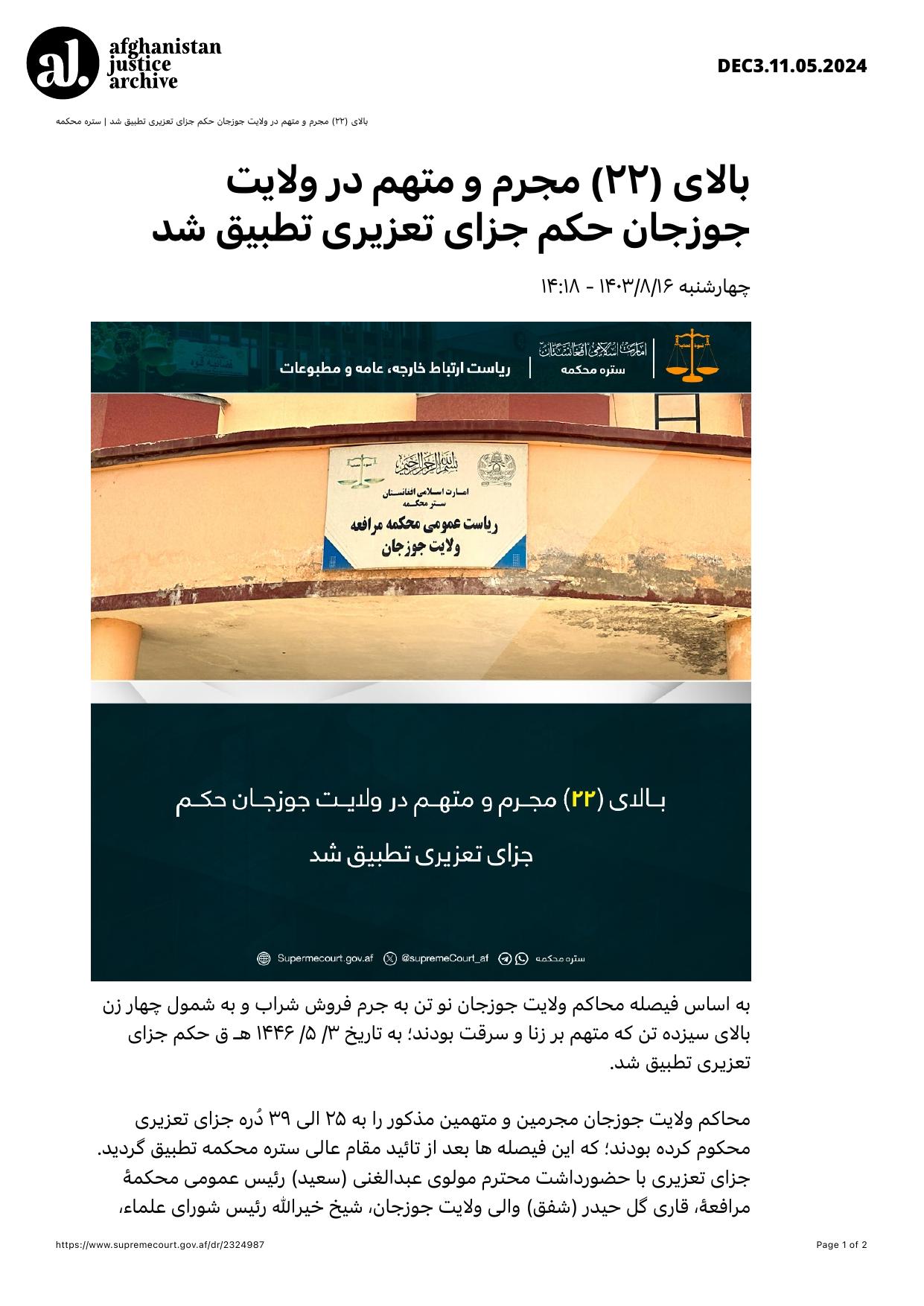
Implementation of Discretionary Criminal Sentences Against 22 Convicted and Accused Individuals in Jawzjan Province
Based on the rulings of the courts in Jawzjan Province, discretionary criminal sentences were executed on 03/05/1446 Hijri Qamari against 22 individuals. This included nine individuals convicted of alcohol trafficking and thirteen others including four women accused of adultery and theft.
The courts of Jawzjan Province had sentenced the convicted and accused individuals to between 25 and 39 lashes as discretionary punishment. These rulings were implemented following their approval by the Supreme Court. The punishments were carried out in public in the presence of Honorable Mawlawi Abdul Ghani (Saeed), Chief Justice of the Appellate Court; Qari Gul Haidar (Shafaq), Governor of Jawzjan Province; Sheikh Khairullah, Head of the Council of Ulema; Mawlawi Abdul Wali (Atiqani), Chief of Police; Haji Haroon, Head of Intelligence; Mawlawi Khair Mohammad (Khairkhwah), Chief Judge of the Urban Court; Mawlawi Asadullah (Hamza), Director of Rural Development; and a large number of local residents.
The session began with the recitation of verses from the Holy Qur’an. Following this, the Governor of Jawzjan spoke about the benefits of implementing discretionary punishments and the harms of succumbing to carnal desires. Subsequently, the Chief Justice of the Appellate Court delivered a detailed and scholarly address on the importance of Hudud and the enforcement of discretionary punishments. The session concluded with prayers following the execution of the sentences. Would you like this translation compiled with the others into a formal report or formatted for publication or advocacy purposes?
The public flogging of 22 individuals in Jawzjan Province constitutes the imposition of cruel, inhuman, and degrading punishment and reflects the systematic use of corporal punishment by Taliban authorities as a tool of governance and moral enforcement. The execution of lashings in a public setting, accompanied by religious instruction and official endorsement, serves to normalize physical violence, collective humiliation, and fear as instruments of social control. The punishment of individuals—including women—on the basis of convictions and accusations, carried out within judicial structures lacking independence, transparency, and due process guarantees, amounts to arbitrary punishment and violates fundamental protections under international human rights law.
Sources
Decree Stats
Area of Decree
Issuer
Type of Decree
Targeted Gender
Delivery Method
Date Published