Decree
Decree Translation
Date: 02/06/1446
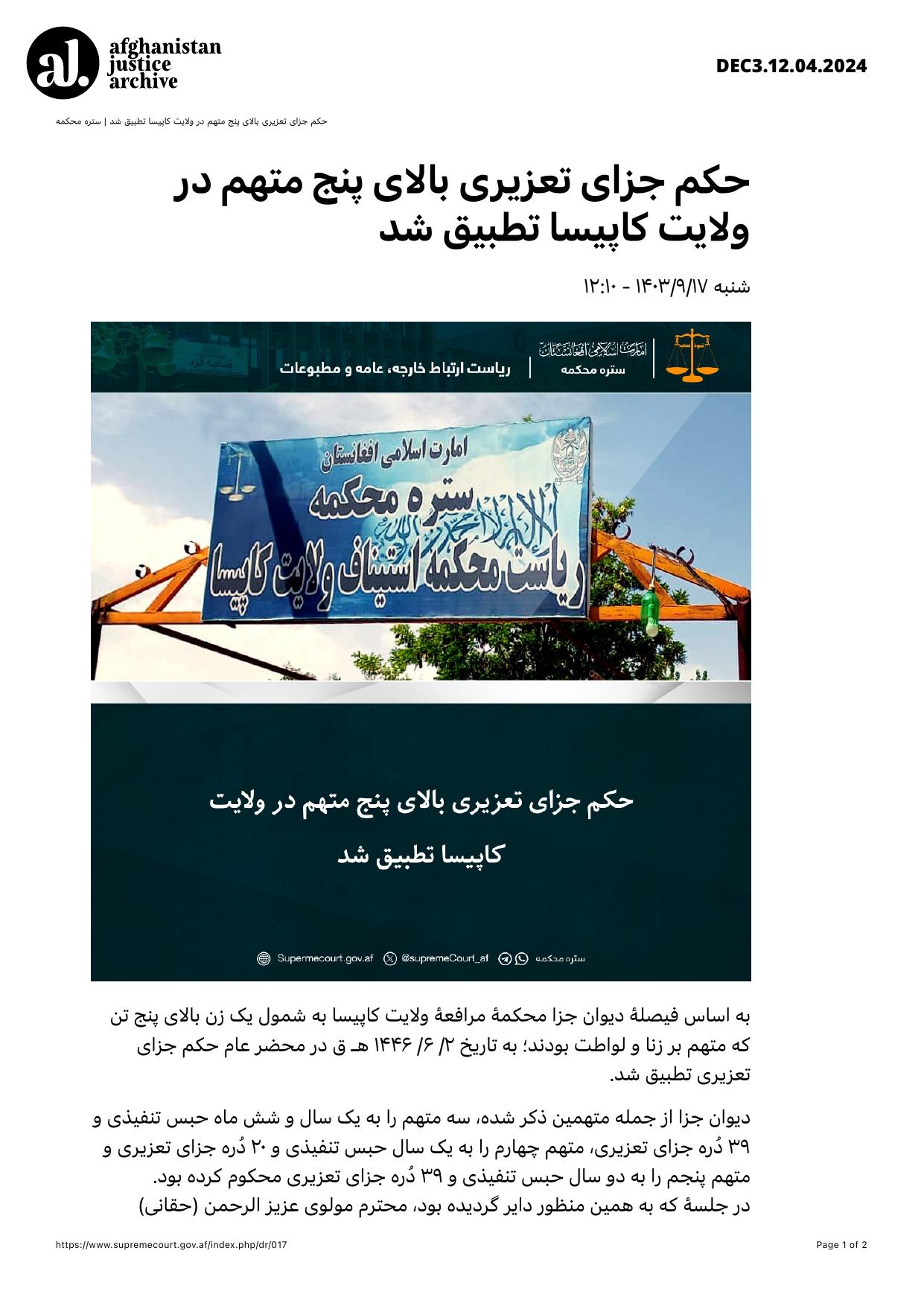
Implementation of Discretionary Criminal Sentences for Five Defendants in Kapisa Province
In accordance with the decision of the Criminal Court of Appeals in Kapisa Province, discretionary criminal sentences were publicly carried out on five individuals, including one woman, who were accused of adultery and sodomy. The sentences were executed on the 2nd of Jumada al-Thani, 1446 AH, in a public gathering.
The Criminal Court sentenced three of the defendants to one year and six months of imprisonment along with 39 lashes as discretionary punishment. The fourth defendant was sentenced to one year of imprisonment and 20 lashes, while the fifth was sentenced to two years of imprisonment and 39 lashes.
The session held for this purpose was attended by respected Mawlawi Azizur Rahman (Haqqani), Chief Judge of the Court of Appeals; Mufti Abdul Rauf (Saadat), Chief Judge of the City Court; judges and administrative staff of both courts; representatives from the provincial governor’s office, the intelligence directorate, the police command, and a large number of local citizens.
The session commenced with the recitation of several verses from the Holy Qur’an by Sheikh Salahuddin, a teacher at the Jihadi Madrasa. Following this, the Chief Judge of the City Court delivered a speech, stating that the aspiration of martyrs and mujahideen over the past 20 years was the implementation of divine laws and limits, and today, by the grace of God, that vision is being realized.
Addressing the mujahideen, he said: “You are the pillars of this system and bear a heavy and critical responsibility. If judges are to implement the divine limits and discretionary punishments, your cooperation is essential. We extend our gratitude to all security and intelligence personnel who tirelessly serve the people day and night.”
At the conclusion of the session, Mawlawi Azizur Rahman (Haqqani), Chief Judge of the Court of Appeals, delivered a motivational speech explaining the purpose of implementing discretionary punishments to the public.
The session ended with a prayer for blessings.
The public flogging and imprisonment of five individuals, including one woman, in Kapisa Province reflects the continued use of discretionary punishment by Taliban authorities as a mechanism of moral enforcement and ideological governance. The execution of custodial sentences and lashings in a public gathering, accompanied by Qur’anic recitation and speeches framing the punishments as the fulfillment of religious and revolutionary duty, underscores the performative and legitimizing role of violence within the judicial system. Charges of “adultery” and “sodomy” rely on intrusive and highly stigmatized moral offenses that criminalize private conduct and enable severe penalties. Carried out through judicial processes lacking independence and meaningful safeguards, the punishments function as arbitrary and coercive practices that reinforce fear, suppress personal autonomy, and normalize physical violence as an accepted tool of rule, with particular implications for gender equality, dignity, and non-discrimination.
Sources
Original Source Link:
Original Decree File:
Decree Stats
Area of Decree
Issuer
Type of Decree
Targeted Gender
Delivery Method
Date Published