Decree
Decree Translation
Date: 17/11/1403
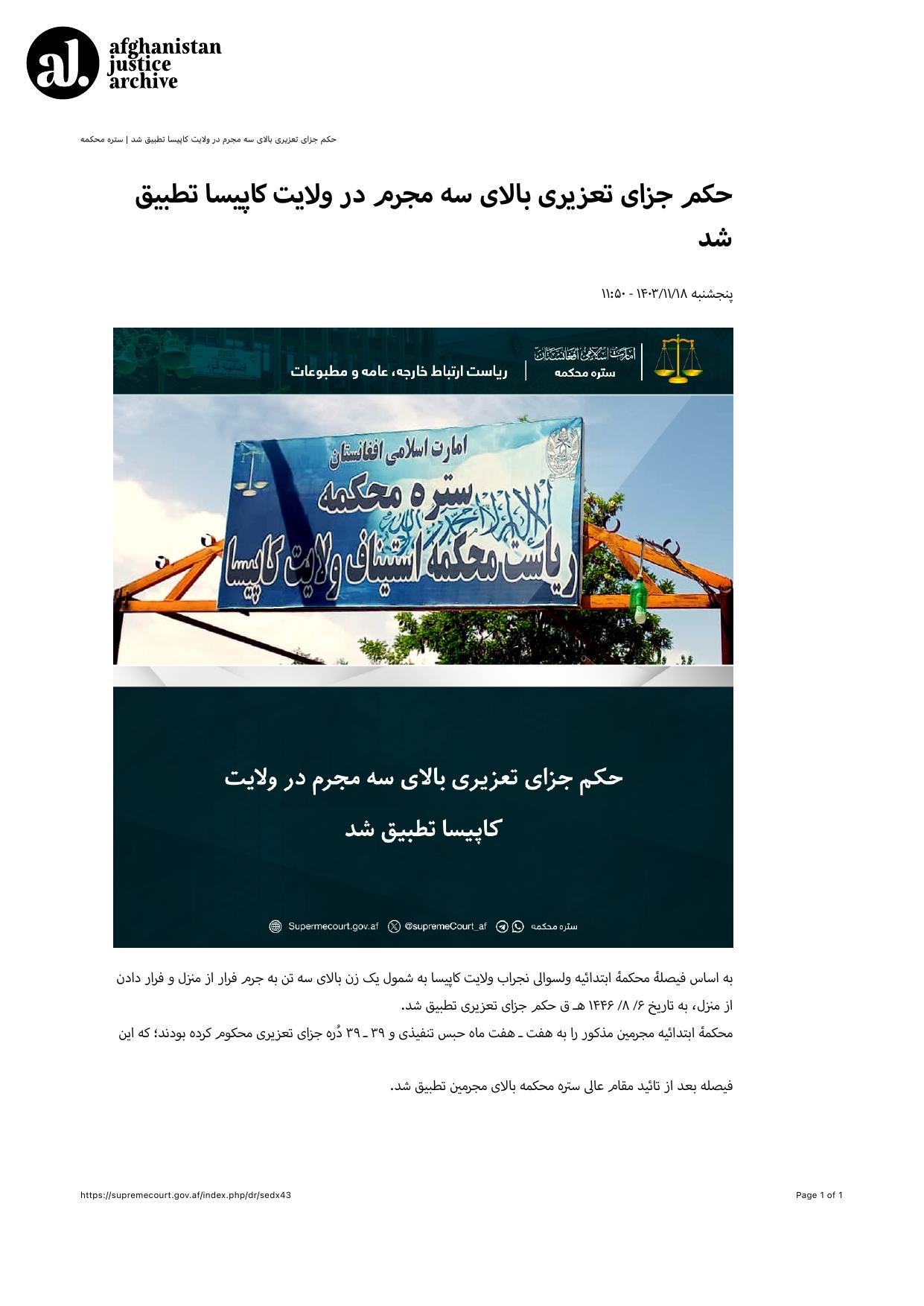
Implementation of Discretionary Criminal Sentences for Three Offenders in Kapisa Province
In accordance with the decision of the Primary Court of Nijrab District, Kapisa Province, a discretionary criminal sentence was executed on 6/8/1446 Hijri (Islamic calendar) against three individuals, including one woman, for the crimes of fleeing from home and aiding in the escape from home.
The Primary Court had sentenced each of the offenders to seven months of imprisonment and 39 lashes as discretionary punishment. This ruling was implemented following its approval by the Supreme Court.
The public sentencing of three individuals, including one woman, in Kapisa Province demonstrates how Taliban judicial mechanisms are used to discipline mobility and family autonomy through punitive force. The combination of imprisonment and corporal punishment for charges related to “fleeing from home” and “aiding escape” reflects an approach that treats personal movement and assistance to others as criminal acts. by enforcing these sentences publicly and following centralized approval, the authorities reinforce punishment as a deterrent spectacle. Carried out within judicial processes that offer no meaningful protection or independence, the sanctions operate as coercive measures that restrict liberty, criminalize autonomy, and disproportionately affect women.
Sources
Original Source Link:
Original Decree File:
Decree Stats
Area of Decree
Issuer
Type of Decree
Targeted Gender
Delivery Method
Date Published