Decree
Decree Translation
Date: 15/05/2025
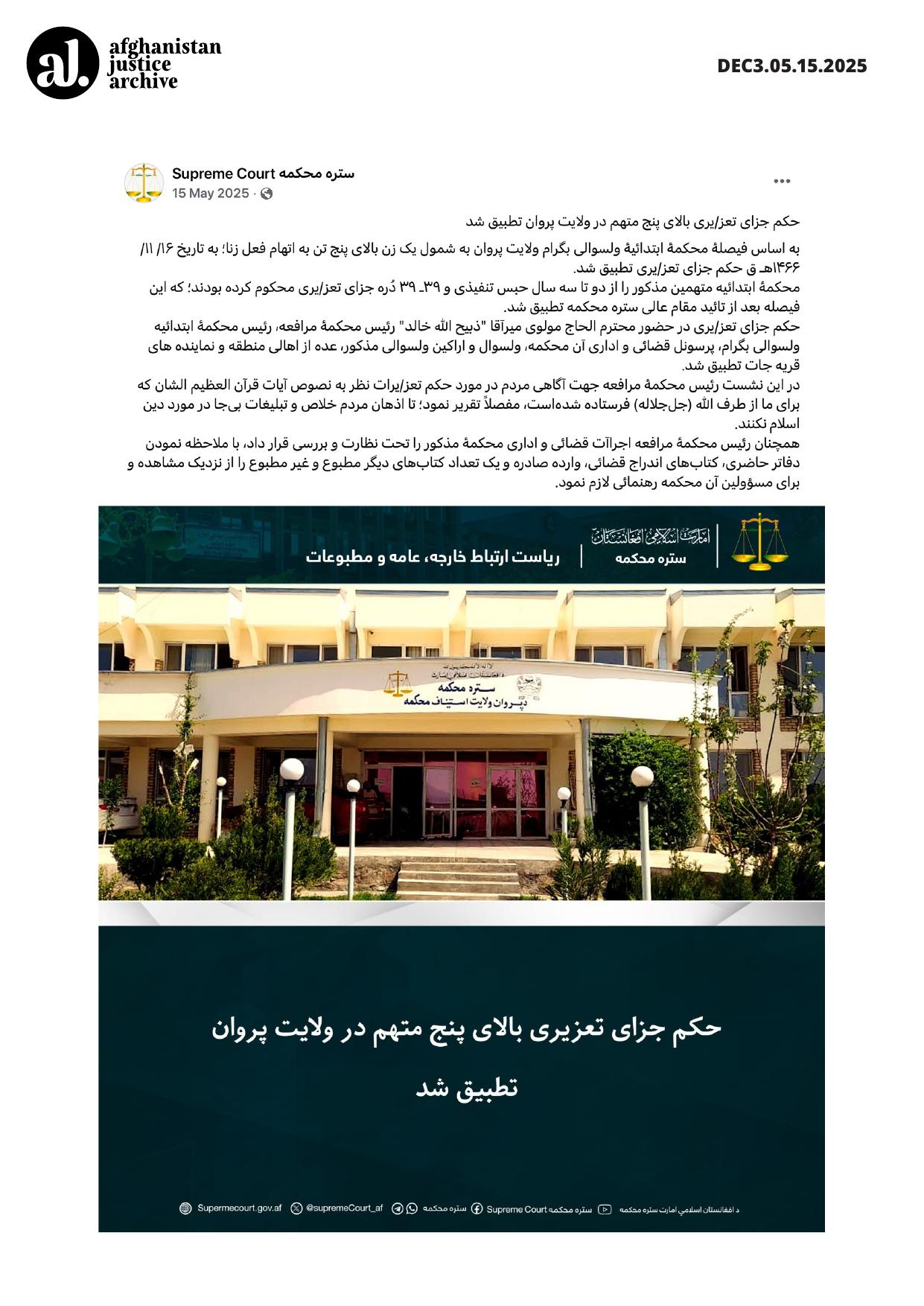
Implementation of Ta’zir Punishment on Five Defendants in Parwan Province
According to the ruling of the Primary Court of Bagram District in Parwan Province, Ta’zir punishment was carried out on five individuals, including one woman, on charges of committing adultery on 16/11/1446 AH.
The Primary Court sentenced the mentioned defendants to two to three years of imprisonment and 39 lashes each as Ta’zir punishment. This decision was implemented after confirmation by the Supreme Court.
The punishment was executed in the presence of respected Al-Haj Mawlawi Mir Aqa “Zabiullah Khalid,” President of the Appellate Court, the President of the Primary Court of Bagram District, judicial and administrative staff of the court, the district governor and officials, a number of local residents, and representatives of the villages.
During the session, the President of the Appellate Court delivered a detailed speech to raise public awareness regarding Ta’zir punishments based on the texts of the Holy Qur’an, which have been sent to us by Allah (Glorified and Exalted be He), in order to dispel misconceptions and prevent unnecessary propaganda against Islam.
Additionally, the President of the Appellate Court supervised and reviewed the judicial and administrative procedures of the mentioned court, inspecting attendance registers, judicial entry books, incoming and outgoing records, and several other printed and non-printed books, and provided necessary guidance to the responsible officials of the court.
This case illustrates the routinized use of corporal punishment alongside imprisonment by Taliban courts, implemented publicly and framed as religious instruction rather than judicial sanction subject to scrutiny. Supreme Court confirmation and the public presence of senior judicial officials underscore institutional endorsement, while the accompanying speech and administrative inspection signal the normalization of punishment as both deterrence and governance practice. The proceedings provide no indication of procedural safeguards or avenues for challenge, reinforcing patterns of arbitrary punishment and denial of fair trial guarantees.
Sources
Original Source Link:
Original Decree File:
Decree Stats
Area of Decree
Issuer
Type of Decree
Targeted Gender
Delivery Method
Date Published