Decree
Decree Translation
Date: 01/03/1447
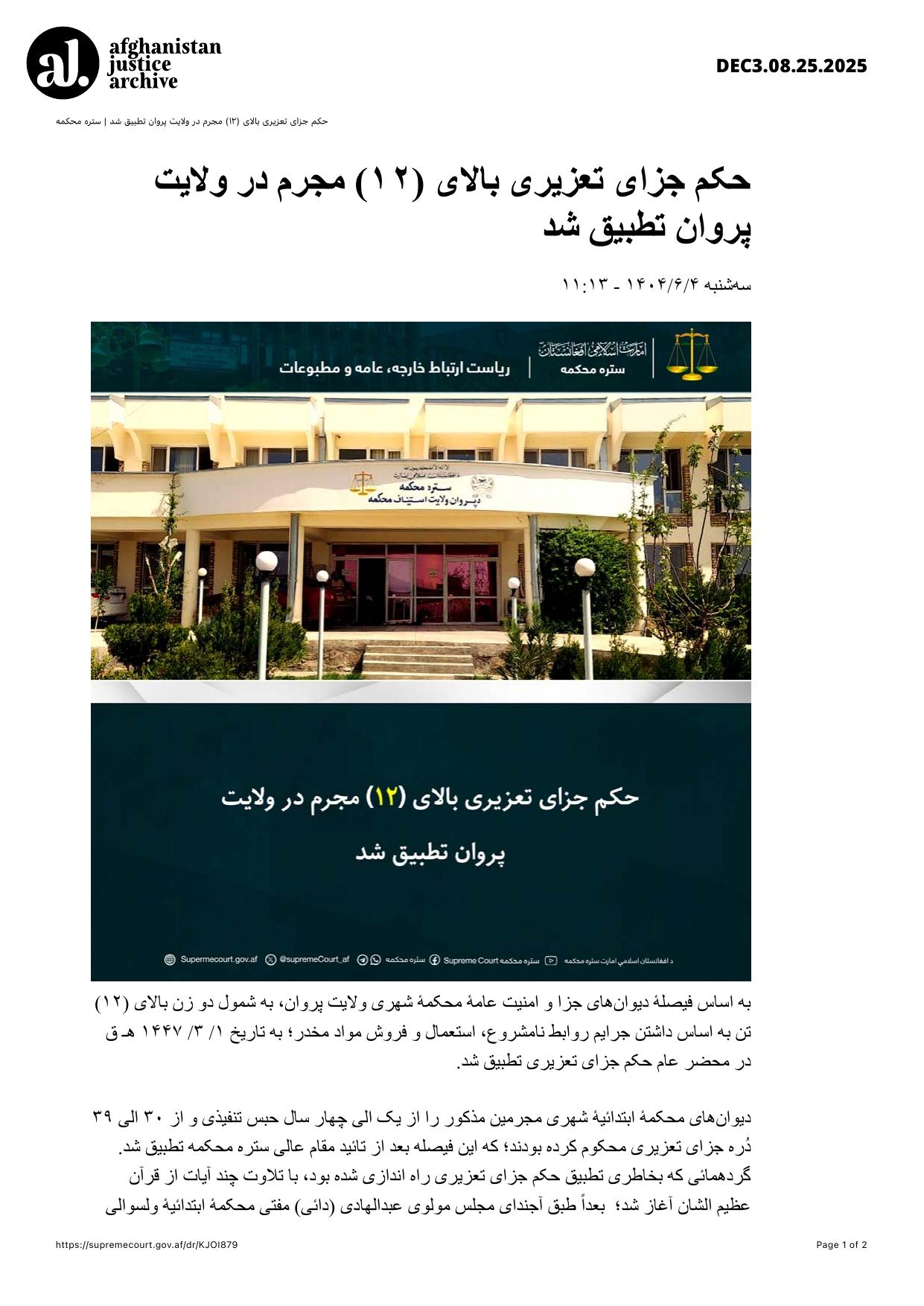
Implementation of Disciplinary Punishment on Twelve Convicted Individuals in Parwan Province
In accordance with the decisions of the Criminal and Public Security Divisions of the Primary Urban Court of Parwan Province, disciplinary punishments were enforced on twelve individuals, including two women, convicted of crimes involving illicit relations, drug use, and drug trafficking. The punishments were carried out publicly on 01/03/1447 AH.
The divisions of the Primary Urban Court had sentenced the convicts to imprisonment ranging from one to four years and disciplinary lashes ranging from 30 to 39 strokes. This ruling was executed after confirmation by the esteemed Supreme Court.
The gathering organized for the implementation of the disciplinary punishment began with the recitation of verses from the Holy Qur’an. Following the agenda, Mawlawi Abdul Hadi (Daee), Mufti of the Primary Court of Sayedkhel District; Mufti Abdul Wali (Haleem), President of the Criminal Division of the Appellate Court; Mufti Abdul Wali (Qari Zada), President of the Parwan Scholars’ Council; Mawlawi Noorullah (Hamad), President of the Primary Urban Court; and Qari Ziaurrahman (Javid), Police Commander of Parwan, each delivered detailed speeches on topics related to the enforcement of Qisas, disciplinary punishments, and the benefits of implementing divine laws in an Islamic society.
Later, Honorable Mawlawi Mir Aqa (Zabiullah Khalid), President of the Appellate Court, addressed the gathering, stating: “In an Islamic country where divine limits and disciplinary punishments are enforced upon criminals, the lives, property, and honor of Muslims remain secure, and such enforcement brings the pleasure of Allah (Glorified and Exalted be He).”
He further added: “The punishments prescribed in the noble religion of Islam for criminals are for the welfare and prosperity of the people.”
The session concluded with a prayer for goodness after the implementation of the disciplinary punishments.
This entry documents the public implementation of disciplinary punishments (taʿzir) on twelve individuals, including two women, in Parwan Province following convictions for illicit relations, drug use, and drug trafficking. Sentences included imprisonment ranging from one to four years and corporal punishment of 30 to 39 lashes, carried out after confirmation by the Supreme Court. The punishments were implemented in a public setting and accompanied by organized speeches from judicial, religious, and security authorities emphasizing the enforcement of Islamic law, moral conduct, and social order. The event reflects the routine use of corporal punishment within the Taliban’s judicial system and the public staging of punishment as a mechanism of deterrence and control.
Sources
Decree Stats
Area of Decree
Issuer
Type of Decree
Targeted Gender
Delivery Method
Date Published