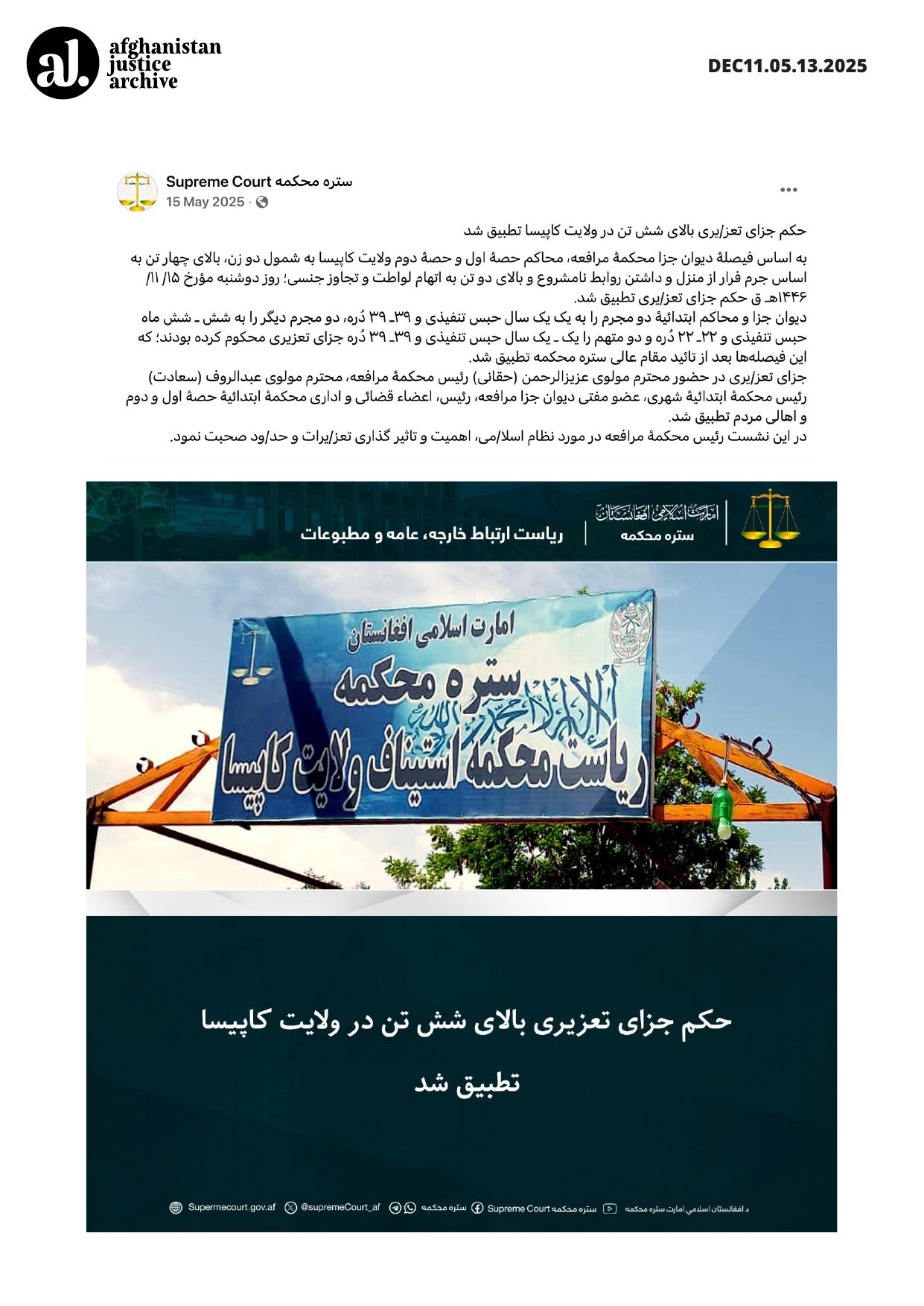
Decree
Decree Translation
Date: 15/11/1446
Implementation of Discretionary Criminal Sentences Against Six Individuals in Kapisa Province
Based on the decision of the Criminal Division of the Court of Appeal, the Primary and Secondary Courts of Kapisa Province implemented discretionary criminal sentences (ta’zir) on six individuals, including two women, on Monday, 15/11/1446 AH. Four of the individuals were sentenced for the crimes of fleeing home and engaging in unlawful relations, and two others were sentenced on charges of sodomy and sexual assault.
The Criminal Division and the Primary Courts had previously sentenced two of the offenders to one year of imprisonment and 39 lashes each; two others to six months of imprisonment and 22 lashes each; and the remaining two accused to one year of imprisonment and 39 lashes each. These verdicts were carried out after being approved by the High Authority of the Supreme Court.
The discretionary punishments were implemented in the presence of Maulawi Aziz‑ur‑Rahman (Haqqani), President of the Court of Appeal; Maulawi Abdul Rauf (Sa’adat), President of the Urban Primary Court; members of the Criminal Division of the Court of Appeal; judicial and administrative members of the Primary Courts of the First and Second Districts; and local residents.
During the gathering, the President of the Court of Appeal spoke about the Islamic legal system and the importance and impact of discretionary and prescribed punishments.
This case reflects the continued use of ta’zir punishments by Taliban courts to regulate personal and sexual conduct through combined imprisonment and corporal punishment. Charges such as “fleeing from home,” “unlawful relations,” sodomy, and sexual assault demonstrate the judicialization of family autonomy and sexual behavior, with women among those punished. Supreme Court approval and the public presence of senior judicial officials underscore institutional endorsement, while the accompanying religious address situates punishment as both legal sanction and moral instruction. No procedural safeguards or defense rights are indicated.
Sources
Decree Stats
Area of Decree
Issuer
Type of Decree
Targeted Gender
Delivery Method
Date Published