Decree
Decree Translation
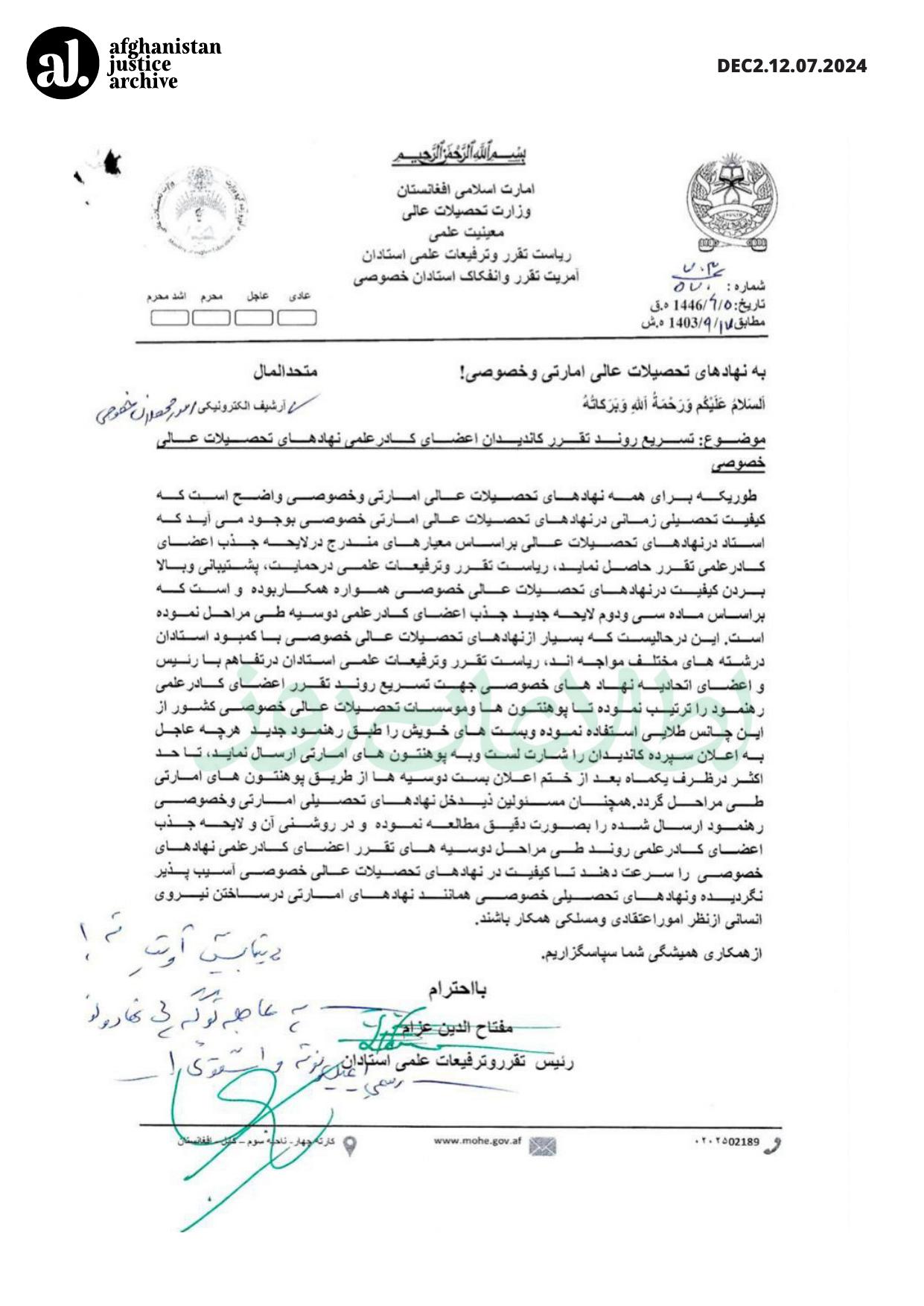
Date: 05/06/1446
To the Public and Private Higher Education Institutions
Peace, mercy, and blessings of Allah be upon you.
Subject: faster the recruitment Process for Academic Staff Candidates in Private Higher Education Institutions
As all public and private higher education institutions know, educational quality in these institutions can only be ensured when instructors are selected according to the criteria stated in the new Regulation on Recruitment of Academic Staff. The Directorate of Appointment and Academic Promotions has always supported private higher education institutions in improving and strengthening their academic quality and based on Article 32 of the new regulation has processed their application files. Meanwhile many private higher education institutions face shortages of instructors in various fields. Therefore in coordination with the President and members of the Private Institutions Union the Directorate of Appointment and Academic Promotions has prepared guidelines to speed up the appointment process of academic staff. Private universities and higher education institutes across the country can use this valuable opportunity to announce their vacant positions as soon as possible according to the new guidelines, shortlist candidates, and send them to public universities. The goal is to have the application files processed through the public universities within one month after the end of the vacancy announcement period. All relevant officials of public and private higher education institutions are asked to carefully study the provided guidelines and in accordance with the Regulation on Recruitment of Academic Staff speed up the processing of academic staff appointment files. This will help ensure that the quality of private higher education institutions is protected and that private institutions like public ones, contribute to building human capacity both in terms of professional skills and religious values.
We appreciate your continuous cooperation.
With respect,
Miftahuddin Azzam
Head of Academic Staff Appointment and Promotions
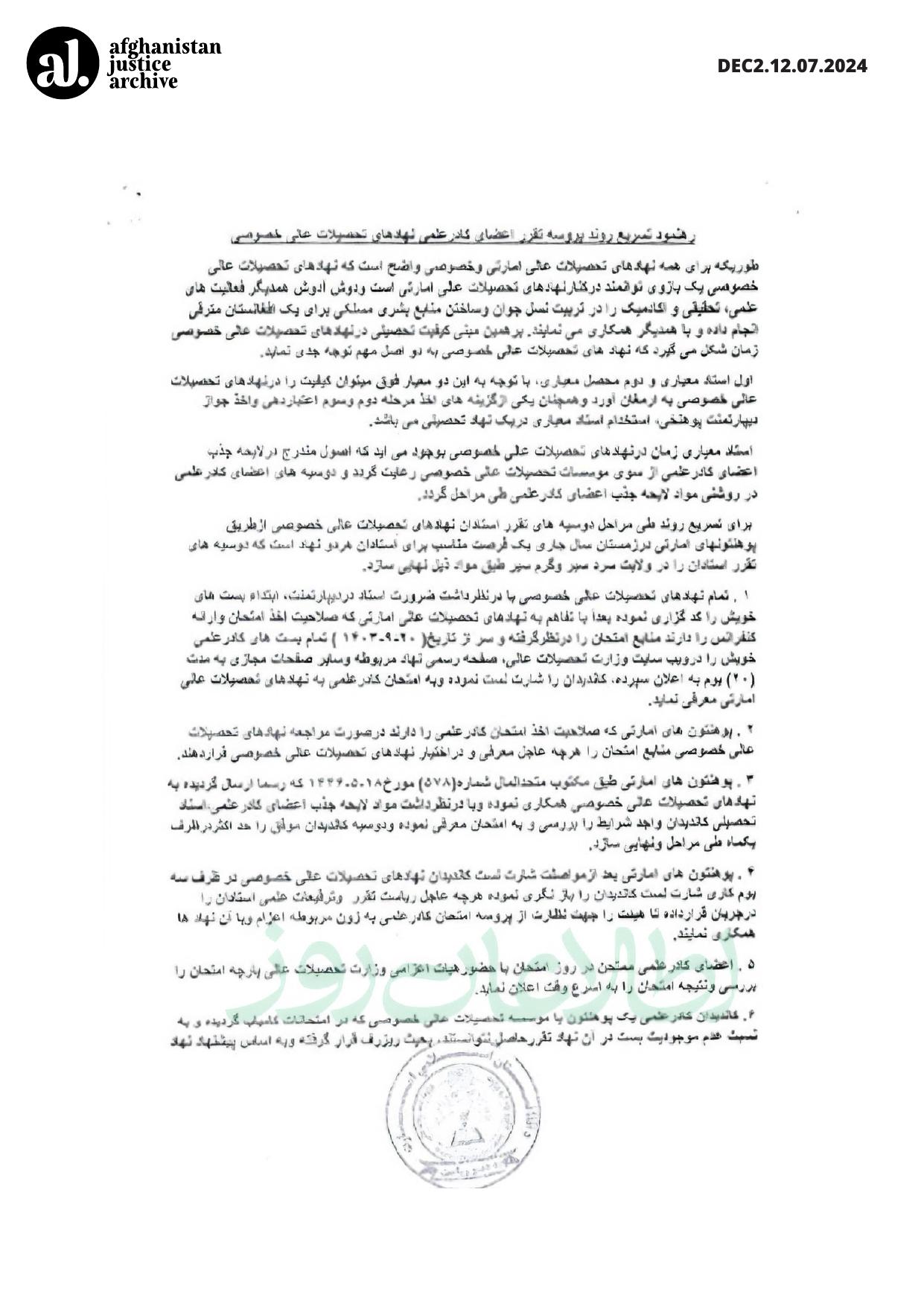
Guidelines to Speed Up the Hiring Process of Academic Staff in Private Higher Education Institutions
As is clear to all public and private higher education institutions private universities and institutes are strong partners alongside public higher education institutions. Together they work shoulder to shoulder in academic, research, and educational activities to train the young generation and build professional human resources for a progressive Afghanistan. Based on this shared mission academic quality in private higher education institutions can be achieved only when they seriously focus on two important principles: Qualified instructors and qualified students. By following these two key principles private higher education institutions can ensure academic quality. In addition one of the key requirements for obtaining the second and third stages of accreditation and receiving permission to establish engineering departments is the recruitment of qualified instructors.
A qualified instructor can only be recruited when private higher education institutions follow the rules and standards outlined in the Regulation on the Recruitment of Academic Staff and process academic staff files according to its articles. To speed up the processing of appointment files for instructors of private higher education institutions through public universities, the winter of this year provides a good opportunity for instructors of both sectors to finalize their appointment files in both cold and warm provinces according to the following points:
1. All private higher education institutions considering their departmental needs must first code their vacant positions. Then in coordination with public universities (which are authorized to conduct academic tests) they must identify exam sources. Starting from 20/09/1403, all academic positions must be announced for 20 days on the Ministry of Higher Education website the official pages of the institution and their social media platforms. After that candidates must be shortlisted and introduced to public universities for the academic exam.
2. Public universities that are authorized to conduct academic staff exams must upon request from private institutions, provide the exam sources as soon as possible.
3. Public universities according to Official Letter No. 578 dated 18/05/1446 must cooperate with private institutions. They must review the academic documents of eligible candidates according to the Regulation on Recruitment of Academic Staff introduce qualified candidates for the exam and complete the processing of successful candidates files within one month.
4. After receiving the shortlist from private institutions, public universities must review the list within three working months and immediately inform the Directorate of Academic Appointments and Promotions so that a monitoring team can be sent to the relevant zone to supervise the exam process and cooperate with the institutions.
5. On the exam day the exam committee must check the answer sheets in the presence of the monitoring team from the Ministry of Higher Education and announce the results as soon as possible.
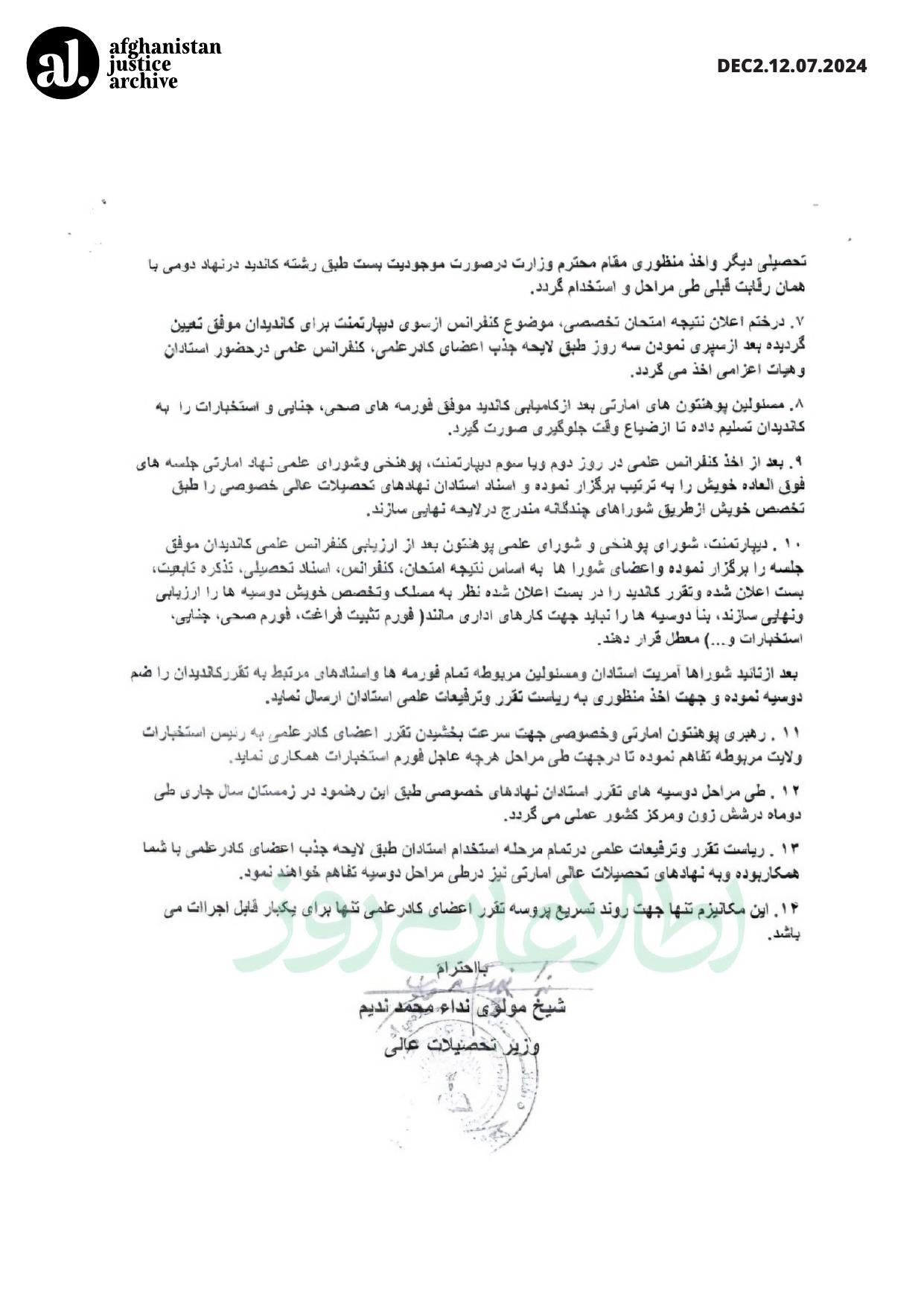
6. Candidates who pass the exam but cannot be appointed due to lack of a vacant position in their institution will be placed on a reserve list. If another private institution has a vacant position in the same field the candidate may be appointed there based on the previous competition after receiving the approval of the Ministry.
7. After the exam results are announced, the department must assign a presentation (conference) topic to successful candidates. Three days later, according to the Recruitment Regulation, the academic presentation will be held in the presence of instructors and the monitoring team.
8. After a candidate passes the exam and presentation public universities must immediately give the health, criminal record, and security clearance forms to the candidate to avoid delays.
9. After the academic presentation the department, faculty, and academic council of the public university must hold their special meetings and finalize the documents of private institution candidates according to their specialization following the different stages outlined in the regulation.
10. The department faculty council, and academic council after evaluating the presentation must meet and finalize the appointment file based on, exam results, presentation academic documents, national ID, announced position, and the candidate’s specialization. Administrative issues such as (graduation verification forms, health forms, criminal record forms, security forms, etc.) should not delay the processing of the appointment files. After approval by the department and academic councils all forms and related documents must be attached to the file and sent to the Directorate of Academic Appointments and Promotions for final approval.
11. The leadership of public and private universities must coordinate with the provincial intelligence office to ensure faster processing of the security clearance forms for academic staff.
12. According to this guideline the appointment files of instructors of private institutions will be processed in the six zones and central regions of the country during the winter of this year within two months.
13. The Directorate of Academic Appointments and Promotions will cooperate with you in all stages of the recruitment process according to the Regulation on Recruitment of Academic Staff and will also coordinate with public universities for processing the files.
14. This mechanism may be used only once and only for the purpose of speeding up the appointment process of academic staff
With respect,
Sheikh Mawlawi Neda Mohammad Nadim
Minister of Higher Education
This directive issued by the Ministry of Higher Education under the Taliban centralizes and securitizes the recruitment of academic staff in private higher education institutions through mandatory oversight by public universities and intelligence authorities. While framed as a quality-assurance measure, the process embeds political and security vetting into academic appointments, undermining institutional autonomy and academic freedom. In the broader context of gender-based exclusions and ideological control, the policy risks reinforcing discriminatory access to academic employment and reshaping higher education as an instrument of state and ideological conformity rather than independent knowledge production.
Sources
Original Source Link:
Original Decree File:
Decree Stats
Area of Decree
Issuer
Type of Decree
Targeted Gender
Delivery Method
Date Published