Decree
Decree Translation
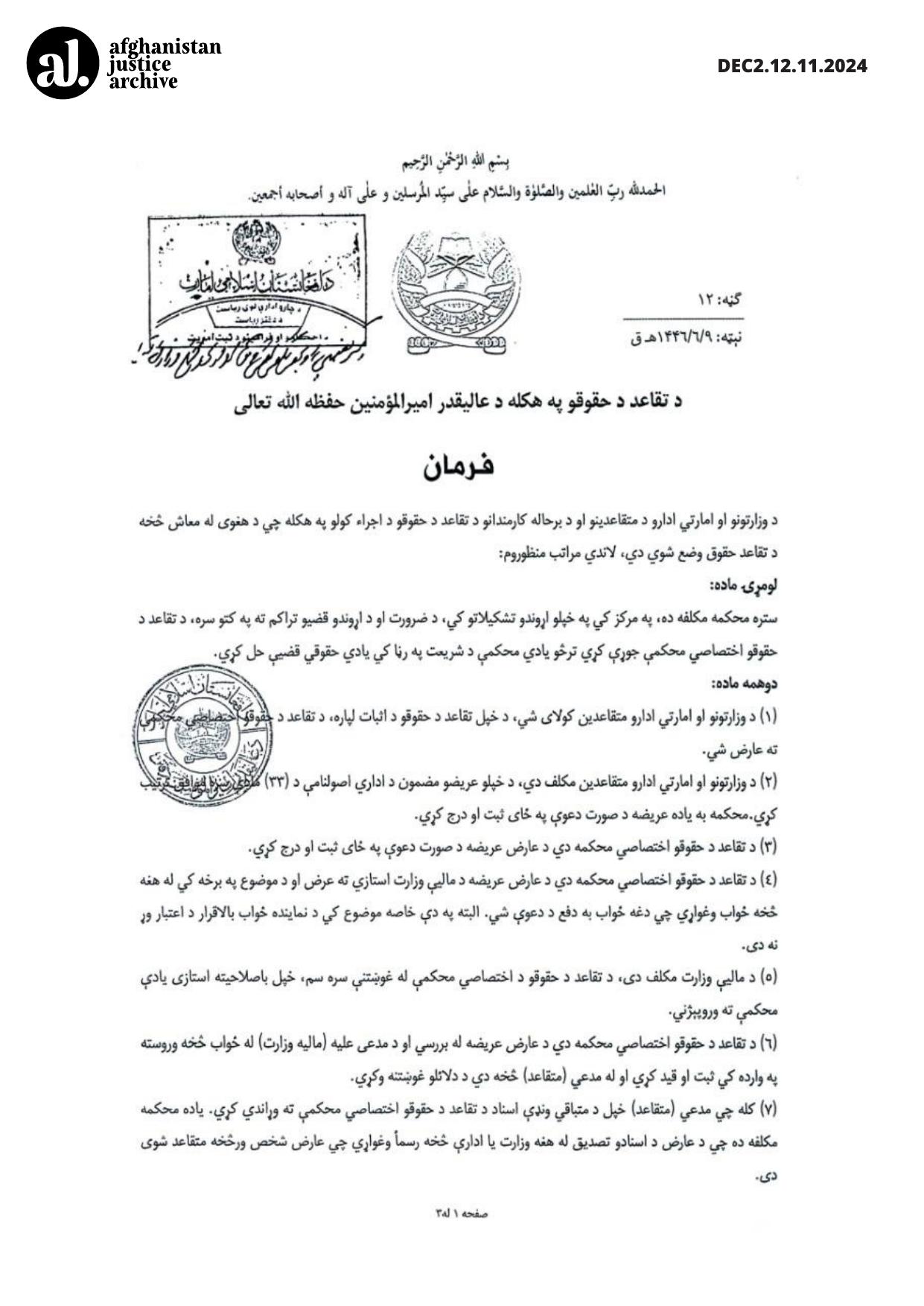
Date: 09/06/1446
Decree of the Esteemed Amir al Muminin (May Allah Protect Him)
Regarding Pension Rights
Concerning the implementation of pension rights for the retired and active employees of ministries and emirate institutions whose pension contributions have been deducted from their salaries the following directives are hereby approved:
Article One:
The Supreme Court is obliged to establish Special Courts for Pension Rights at the central and related provincial levels as needed and in consideration of the volume of related cases. These courts shall adjudicate such matters in the light of Islamic Sharia.
Article two:
1. Retired employees of ministries and emirate institutions may submit their petitions to the Special Court for Pension Rights to claim or prove their pension entitlements.
2. Retired employees are required to prepare their petitions in accordance with Article (33) of the Administrative Procedures Regulation and file them with the said court instead of a regular lawsuit.
3. The Special Court for Pension Rights shall register and record the petition in place of a lawsuit form.
4. The Special Court for Pension Rights shall forward the petition to the representative of the Ministry of Finance and request a response on the matter however the representative’s response shall not be considered as binding admission.
5. The Ministry of Finance is obliged to introduce an authorized representative to the Special Court for Pension Rights upon the court’s request.
6. After reviewing the petition and the Ministry of Finance’s response, the Special Court for Pension Rights shall record the case and request supporting evidence from the plaintiff (the retiree).
7. Once the retiree submits the remaining relevant documents, the court is required to formally seek verification of these documents from the ministry or department from which the retiree was discharged.
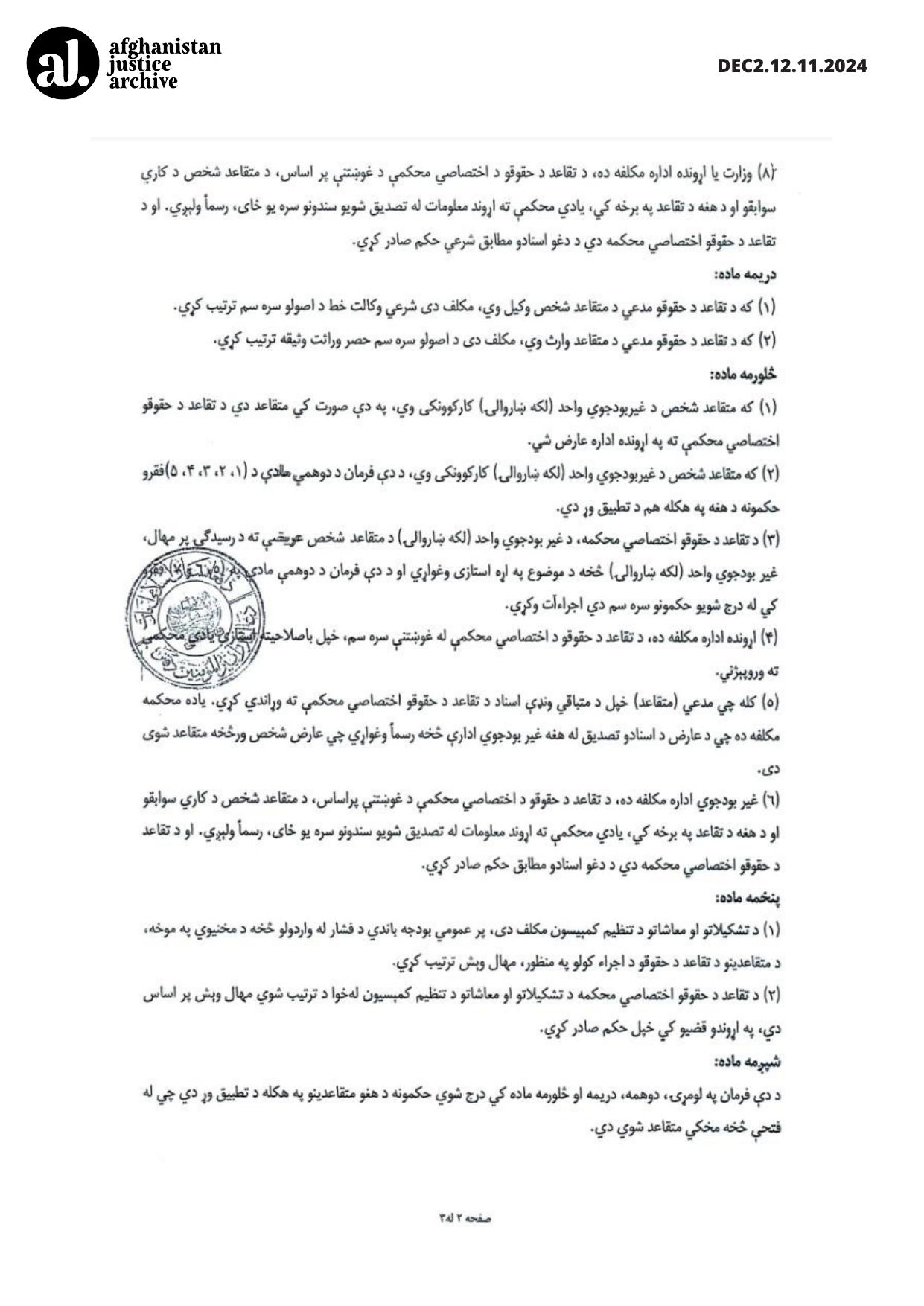
8.The relevant ministry or department must upon the request of the Special Court for Pension Rights, officially provide the retiree’s employment history and certified pension related documents to the court. The Special Court for Pension Rights shall then issue a Sharia based ruling in accordance with the verified documents.
Article Three:
1. If the claimant of a retiree’s pension rights is a personal representative (attorney) he must prepare a legal power of attorney in accordance with Sharia and procedural principles.
2. If the claimant of the retiree’s pension rights is an heir he must prepare a formal certificate of inheritance according to established procedures.
Article Four:
1. If the retiree was an employee of a non-budgetary entity (such as a municipality) the retiree shall submit his petition to the competent Special Court for Pension Rights through the relevant authority.
2. The provisions of subparagraphs (1-5) of Article Two of this decree shall also apply to employees of non-budgetary entities.
3. When the Special Court for Pension Rights handles the petition of a retiree from a non-budgetary entity (e.g. a municipality) it must request relevant documentation from that entity and proceed in accordance with the provisions of Article Two of this decree.
4. The relevant entity is obliged to officially introduce an authorized representative to the Special Court for Pension Rights.
5. Once the retiree submits his remaining documents to the Special Court for Pension Rights the court must formally seek verification of these documents from the non-budgetary entity from which the retiree was discharged.
6. The non-budgetary entity is required upon request of the Special Court for Pension Rights to officially provide the retiree’s employment history and certified pension related documents. The court shall issue its ruling based on these verified documents.
Article Five:
1. The Commission for the Regulation of Structures and Salaries is obliged to prepare a schedule for the implementation of retirees’ pension payments in order to avoid imposing pressure on the general budget.
2. The Special Court for Pension Rights shall issue its judgments in related cases in accordance with the schedule established by the said Commission.
Article Six:
The provisions set out in Articles One, Two, Three, and four of this decree shall apply to those retirees who were retired prior to the liberation of the Emirate.
Article Seven:
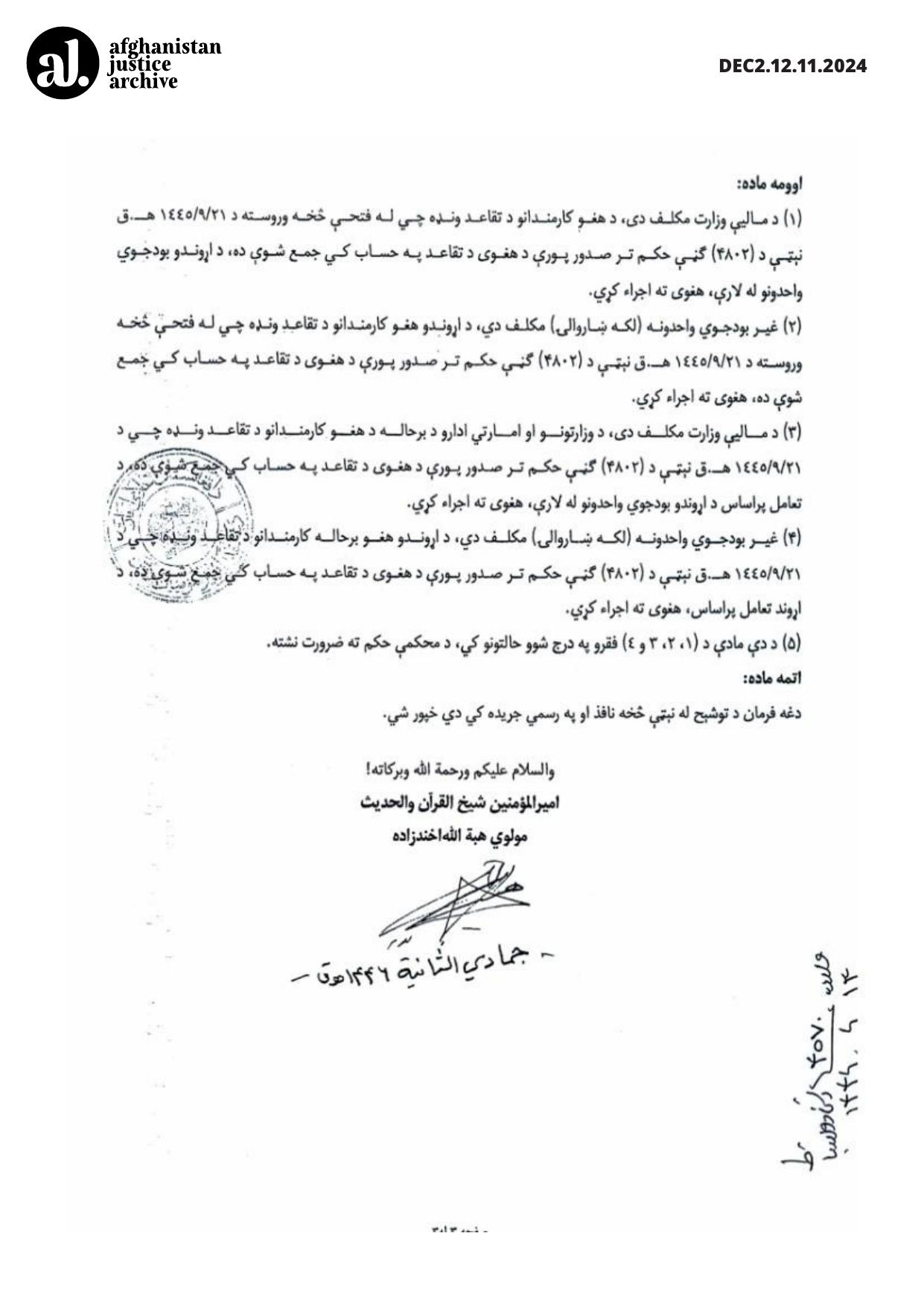
1.The Ministry of Finance is obliged to execute, through the relevant budgetary units the pension shares of employees whose contributions were collected after the victory of the Islamic Emirate and up to 21 Ramadan 1445 Hijri Qamari (corresponding to decree No. 4802).
2. Non-budgetary entities (such as municipalities) must likewise execute the pension shares of their employees collected within the same period in accordance with relevant regulations.
3.The Ministry of Finance shall also pay through the relevant budgetary units the pension contributions of active employees of ministries and emirate institutions collected up to 21 Ramadan 1445 Hijri Qamari (decree No. 4802).
4. Non-budgetary entities (such as municipalities) must likewise pay the pension contributions of their active employees collected within that period in accordance with applicable procedures.
5. In the circumstances outlined in paragraphs (1, 2, 3, and 4) of this article no court ruling shall be required.
Article Eight:
This decree shall come into effect from the date of endorsement and shall be published in the Official Gazette.
Wa Assalamu Alaikum wa Rahmatullahi wa Barakatuh
Amir al Muminin Sheikh al Quran wal-Hadis Mawlawi Haibatullah Akhundzada
This decree issued by Haibatullah Akhundzada formalizes a Sharia-based mechanism for adjudicating pension claims through Special Courts under the authority of the Taliban, centralizing control over social security entitlements. While framed as an administrative measure, the decree lacks guarantees of independence, equality before the law, or effective remedy, and embeds discretionary budgetary constraints that may delay or deny pensions owed to retirees. In the broader context of systemic exclusions and institutionalized discrimination, particularly against women and former public servants, the decree risks reinforcing unequal access to livelihoods and justice under a parallel legal system.
Sources
Original Source Link:
Original Decree File:
Decree Stats
Area of Decree
Issuer
Type of Decree
Targeted Gender
Delivery Method
Date Published