Decree
Decree Translation
Date: 19/10/1403
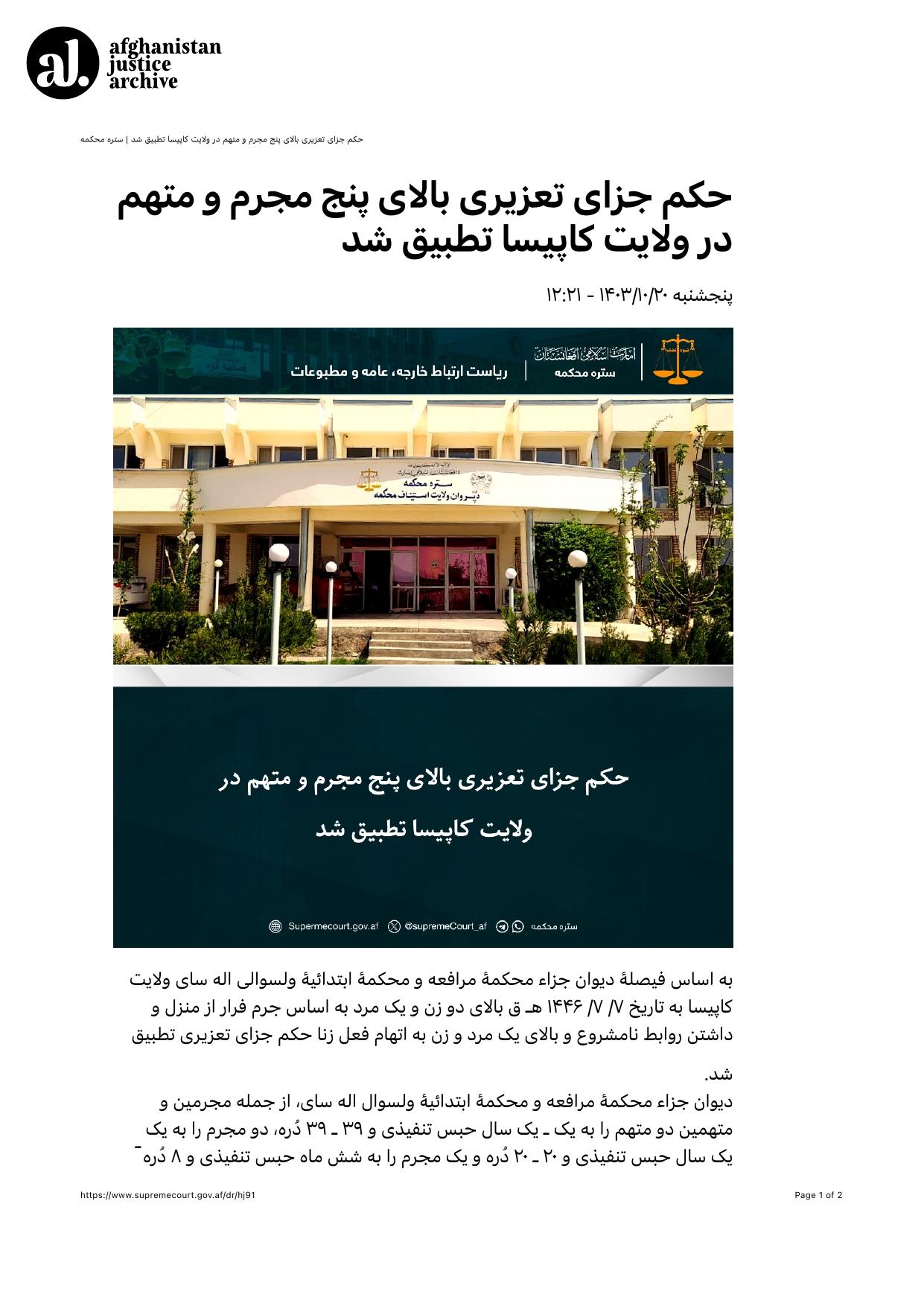
Implementation of Discretionary Criminal Sentences for Five Offenders and Accused Individuals in Kapisa Province
In accordance with the rulings of the Criminal Division of the Court of Appeals and the Primary Court of Alasay District in Kapisa Province, discretionary criminal sentences were publicly executed on the 7th of Rajab, 1446 AH. The sentences were carried out against two women and one man for the crimes of fleeing from home and engaging in illicit relationships, and against one man and one woman for the crime of adultery.
The Criminal Division of the Court of Appeals and the Primary Court of Alasay District sentenced two accused individuals to one year of imprisonment each and 39 lashes each. Two convicted individuals were sentenced to one year of imprisonment each and 20 lashes each. One convicted individual was sentenced to six months of imprisonment and 8 lashes. These rulings were implemented after receiving approval from the Supreme Court.
The gathering held for this purpose was attended by respected Mawlawi Azizur Rahman (Haqqani), Chief Judge of the Court of Appeals in Kapisa Province; officials from the police command, intelligence services, the provincial governor’s office; and other relevant government authorities.
During the gathering, the Chief Judge of the Court of Appeals delivered a comprehensive speech on the importance of implementing discretionary punishments and the significance of the Islamic legal system.
The session concluded with a prayer for blessings following the execution of the sentences.
The public enforcement of imprisonment and corporal punishment against five individuals, including three women, in Kapisa Province reflects the continued use of discretionary punishment by Taliban authorities to regulate personal behavior through moral policing and public spectacle. The execution of sentences for charges such as “fleeing from home,” “illicit relationships,” and “adultery,” carried out publicly following Supreme Court approval and accompanied by ideological speeches, underscores the performative role of punishment in enforcing social conformity. These charges intrude deeply into private and family life and disproportionately affect women. Implemented through judicial processes lacking independence and meaningful safeguards, the punishments function as arbitrary and coercive practices that undermine personal autonomy, liberty, dignity, and gender equality, while normalizing public violence as a tool of governance.
Sources
Decree Stats
Area of Decree
Issuer
Type of Decree
Targeted Gender
Delivery Method
Date Published