Decree
Decree Translation
Date: 28/11/1403
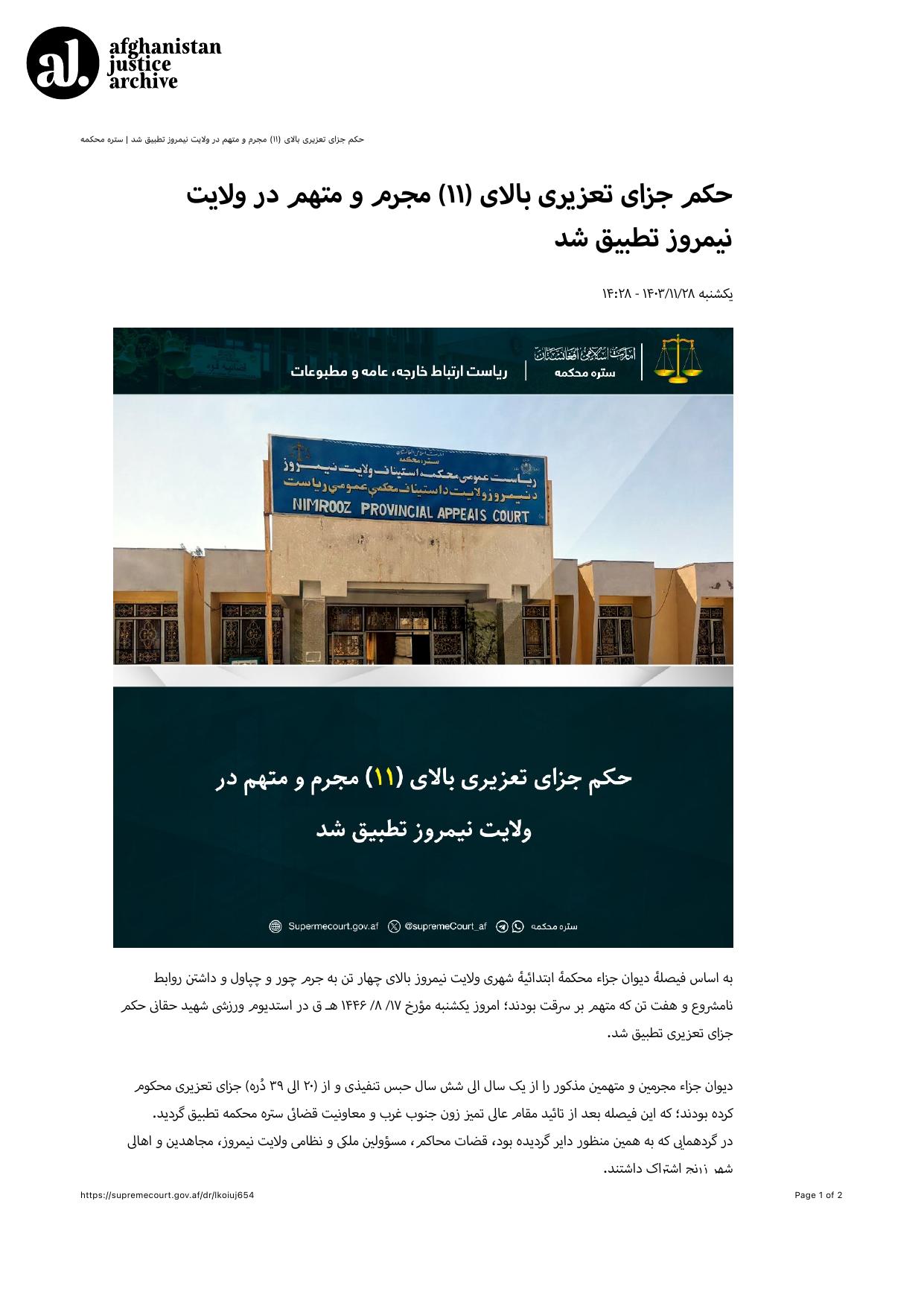
Implementation of Discretionary Criminal Sentences for Eleven Offenders and Accused Individuals in Nimroz Province
In accordance with the ruling of the Criminal Division of the Primary Urban Court of Nimroz Province, discretionary criminal sentences were publicly executed today, Sunday (17th Rabi al-Awwal, 1446 AH), at the Shaheed Haqqani Sports Stadium. The sentences were carried out against four individuals convicted of robbery and illicit relationships, and seven individuals accused of theft.
The Criminal Division had sentenced the offenders and accused to imprisonment ranging from one to six years, and lashes ranging from 20 to 39 as discretionary punishment. These rulings were implemented after receiving approval from the High Appellate Authority of the Southwestern Zone and the Judicial Deputy of the Supreme Court.
The gathering held for this purpose was attended by judges of the courts, civilian and military officials of Nimroz Province, members of the Mujahideen, and residents of Zaranj city.
The session began with the recitation of the Holy Qur’an. Following this, Mawlawi Qudratullah Rafat, Head of the Civil Division of the Primary Urban Court, delivered a scholarly speech on the importance of implementing divine rulings and urged the public to reform their conduct.
The public sentencing of eleven individuals in Nimroz Province illustrates the use of discretionary punishment to combine criminal justice with ideological spectacle. The execution of imprisonment and lashings in a sports stadium, accompanied by religious recitation and moral instruction, frames punishment as a public lesson rather than a narrowly tailored legal response. The inclusion of both convicted and accused individuals, sentenced to varying terms of imprisonment and corporal punishment, underscores the fluid boundary between accusation and conviction within Taliban judicial practice. Implemented through processes lacking independence and meaningful safeguards, these punishments function as arbitrary measures that normalize public violence, undermine personal autonomy and liberty, and reinforce fear and conformity within the broader community.
Sources
Decree Stats
Area of Decree
Issuer
Type of Decree
Targeted Gender
Delivery Method
Date Published