Decree
Decree Translation
Date: 30/11/1403
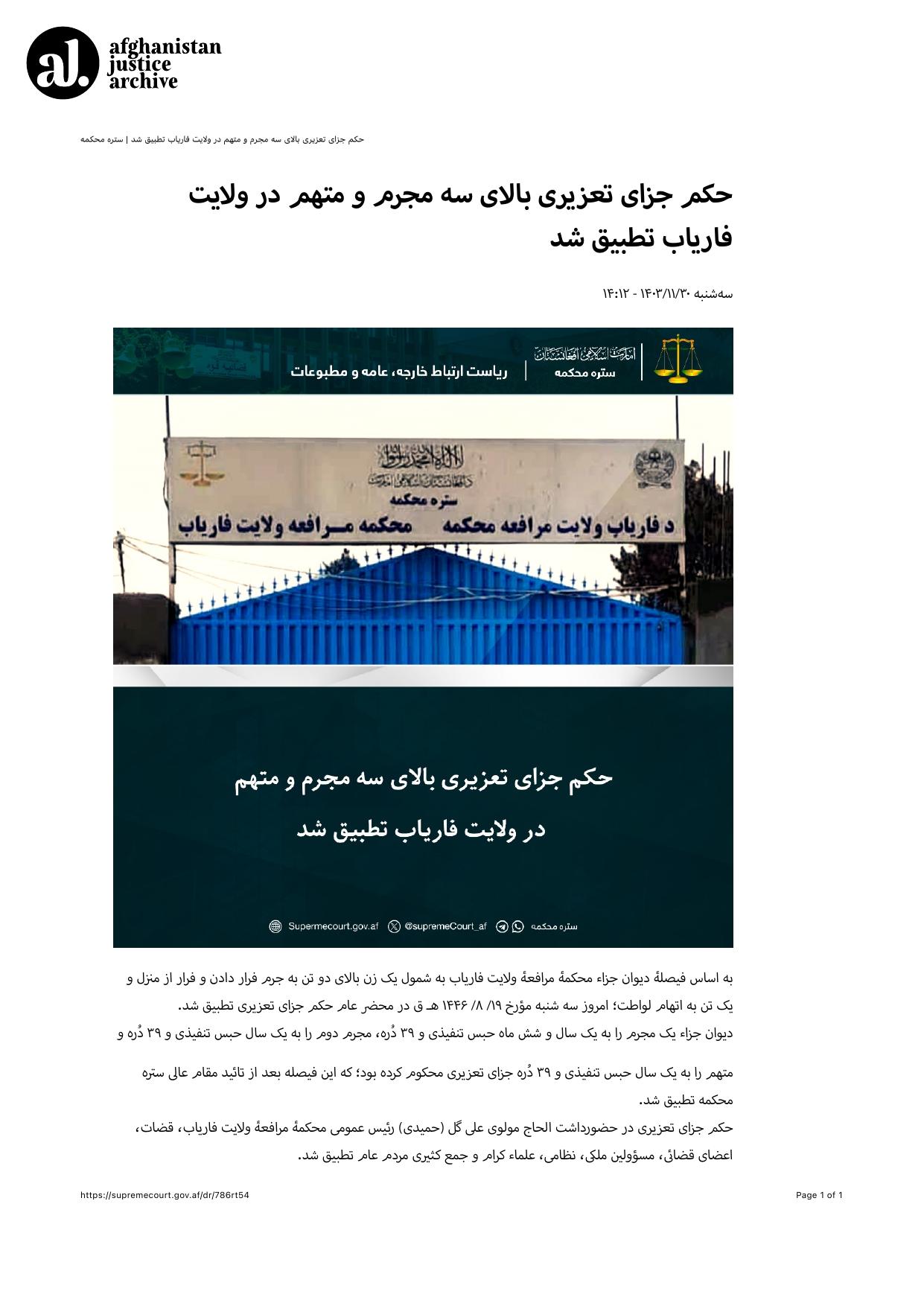
Implementation of Discretionary Criminal Sentences for Three Individuals in Faryab Province
In accordance with the ruling of the Criminal Division of the Appellate Court of Faryab Province, a discretionary criminal sentence was publicly executed today, Tuesday, 19/8/1446 Hijri (Islamic calendar), against three individuals — including one woman for the crimes of aiding and committing escape from home, and one individual charged with sodomy.
The Criminal Division had sentenced one offender to one year and six months of imprisonment and 39 lashes, the second offender to one year of imprisonment and 39 lashes, and the accused to one year of imprisonment and 39 lashes as discretionary punishment. This ruling was implemented following its approval by the Supreme Court.
The sentence was carried out in the presence of Al-Haj Mawlawi Ali Gul (Hamidi), Chief Justice of the Appellate Court of Faryab Province, along with judges, judicial members, civil and military officials, respected religious scholars, and a large gathering of the general public.
The public punishment of three individuals, including one woman, in Faryab Province illustrates the use of discretionary sentencing to criminalize personal autonomy, movement, and intimate conduct through punitive force. The combination of imprisonment and corporal punishment for charges related to “escaping from home” and “sodomy,” imposed following centralized judicial approval and carried out before a large public audience, reinforces punishment as a tool of deterrence and moral discipline. The involvement of senior judicial, security, and religious officials underscores the institutional coordination behind these acts. Implemented through judicial processes lacking independence or meaningful safeguards, the sentences function as arbitrary measures that suppress liberty, stigmatize private behavior, and disproportionately expose women and marginalized individuals to coercive punishment.
Sources
Decree Stats
Area of Decree
Issuer
Type of Decree
Targeted Gender
Delivery Method
Date Published