Decree
Decree Translation
Date: 30/11/1403
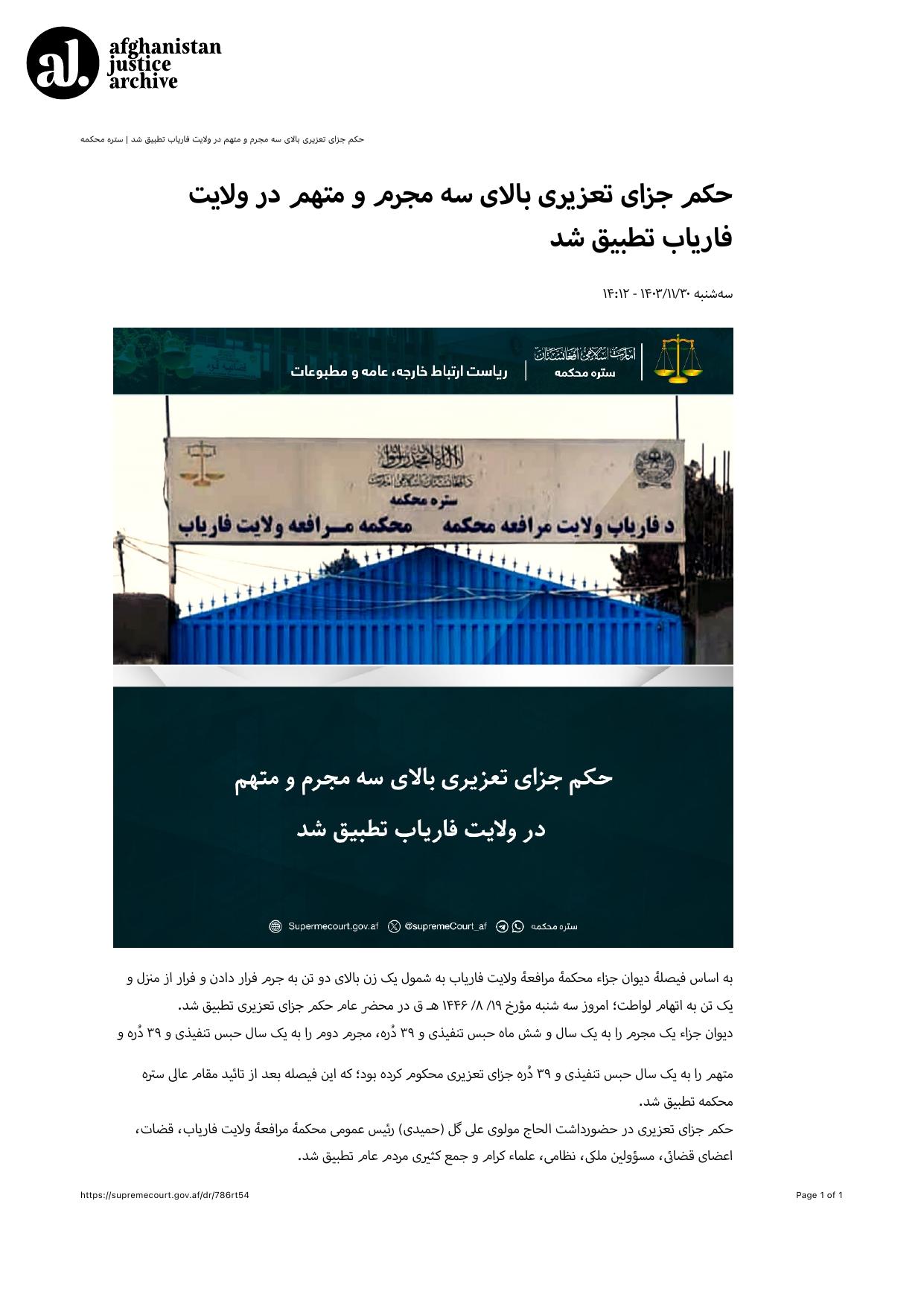
According to the decision of the Criminal Division of the Faryab Provincial Court of Appeals, a discretionary punishment was carried out in public today, Tuesday, 19/08/1446 AH, against three individuals, including one woman, convicted of charges related to absconding and facilitating escape from home, and one individual accused of sodomy. The Criminal Division had sentenced the first offender to one year and six months of imprisonment and 39 lashes, the second offender to one year of imprisonment and 39 lashes, and the accused to one year of imprisonment and 39 lashes as discretionary punishment. This ruling was implemented following approval by the Supreme Court. The punishment was executed in the presence of Al-Haj Mawlawi Ali Gul (Hamidi), Chief of the Faryab Provincial Court of Appeals, judges, judicial members, civil and military officials, respected scholars, and a large gathering of the general public.
The public imprisonment and flogging of three individuals, including one woman, in Faryab Province reflects the continued use of discretionary punishment by Taliban authorities as a means of enforcing moral conformity and social control. The execution of custodial sentences and corporal punishment in a public setting, following Supreme Court approval and attended by senior judicial, civil, military, and religious figures, underscores the performative nature of punishment and its role in disciplining the wider community. Charges related to “absconding” and “facilitating escape from home,” alongside an accusation of “sodomy,” rely on vague, intrusive, and stigmatizing moral offenses that criminalize private conduct and disproportionately impact women and sexual minorities. Carried out through judicial processes lacking independence and meaningful safeguards, the punishments function as arbitrary and coercive practices that undermine personal autonomy, liberty, dignity, and non-discrimination, while normalizing physical violence as an instrument of governance.
Sources
Decree Stats
Area of Decree
Issuer
Type of Decree
Targeted Gender
Delivery Method
Date Published