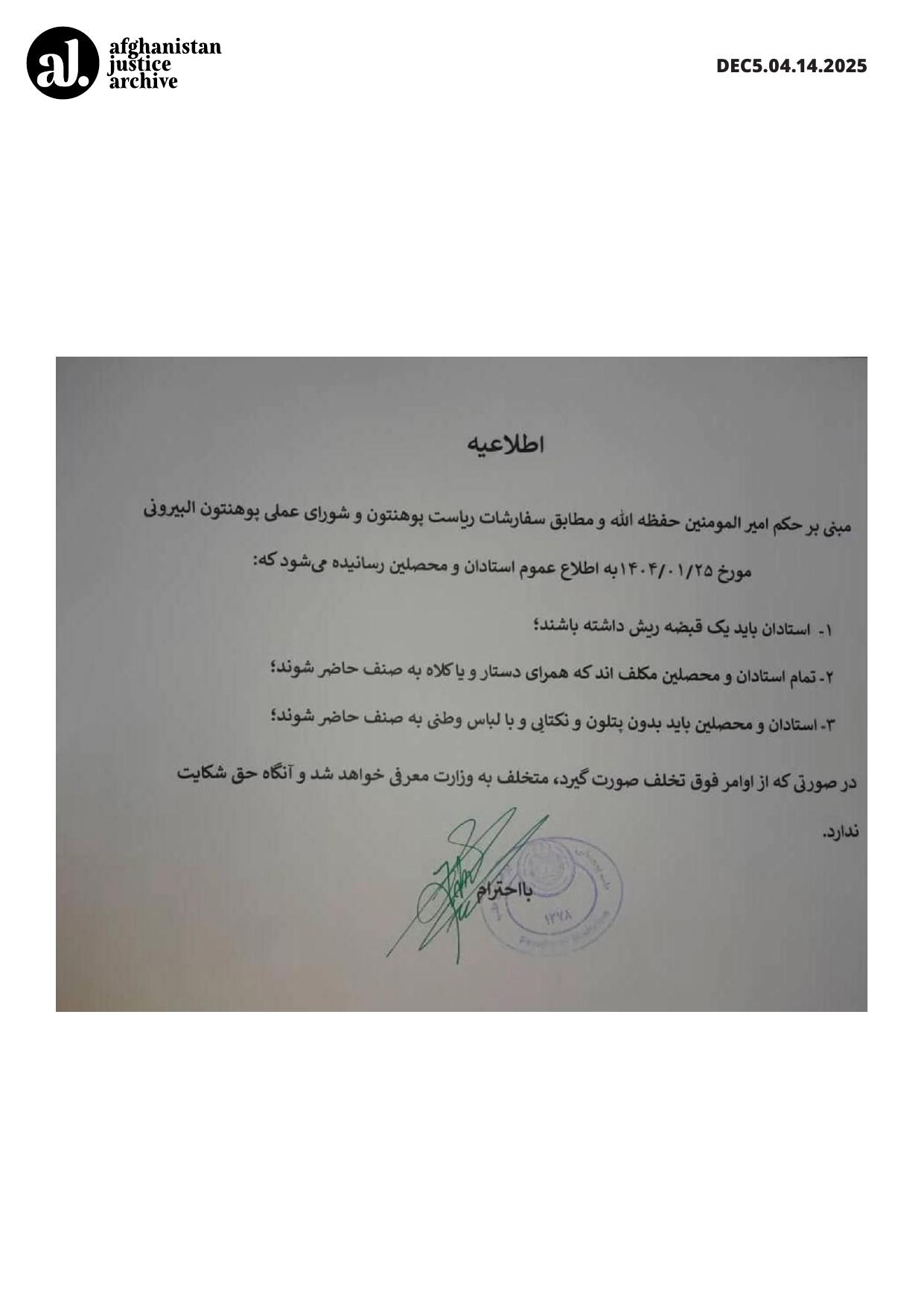
Decree
Decree Translation
Date: 22/01/1404
Location: Badghis (Qala-e-Naw), Nimroz (Zaranj), Farah (Farah City)
Public Executions of Four Men Carried Out in Three Provinces on the Same Day
The Taliban Supreme Court announced on Friday, 11 April 2025, that four men were publicly executed in three provinces of Afghanistan on the same day.
According to separate statements issued by the court, two men—identified as Salman and Haidar—were executed in Qala-e-Naw, the capital of Badghis Province, on charges of murder. The court stated that the sentences were carried out as qisas (retribution) following confirmation by the Taliban’s leader, Haibatullah Akhundzada.
In a separate announcement, the Supreme Court reported the public execution of Abdul Qadir, a resident of Nimroz Province, at a stadium in Zaranj, the provincial capital. The court also announced the execution of Mohammad Sadiq in a stadium in Farah City, Farah Province, likewise on charges of murder.
The Taliban stated that the executions were carried out in public, in the presence of civilian and military officials and members of the public. Prior to the executions, Taliban authorities issued calls for residents in the three Provinces to attend. Attendees were instructed not to bring weapons or mobile phones. No footage of the executions has been publicly released.
With these executions, the number of individuals publicly executed by the Taliban since August 2021 has reportedly risen to at least nine, though the actual figure may be higher due to the lack of transparent reporting and restrictions on independent documentation. The United Nations, human rights organizations and human rights defenders have condemned the executions, calling them "field courts" due to the defendants' lack of access to justice. The Taliban's courts operate largely on the basis of a specific interpretation of Islamic law and customary law, and their judicial practices differ from civil law and international human rights standards. Many human rights organizations have criticized the lack of transparency in the judicial process, the lack of access to lawyers for defendants, and the rapid and sometimes coercive process of trials in Taliban courts.Reports indicate that defendants are convicted in Taliban courts without a lawyer and sometimes without sufficient evidence.
The coordinated public execution of four individuals across three provinces on the same day represents a significant escalation in the Taliban’s use of capital punishment as a public instrument of governance. by staging executions in stadiums and provincial capitals, mobilizing public attendance, and centralizing authorization under the Taliban leader, the authorities frame retribution as both judicial enforcement and public spectacle. The prohibition on filming underscores an effort to control narrative visibility while still leveraging fear through physical presence. The simultaneity and geographic spread of the executions indicate deliberate signaling of state power and deterrence, rather than isolated judicial outcomes. Implemented within a system lacking transparency, independent oversight, and due process guarantees, these executions raise serious concerns regarding arbitrary deprivation of life and the normalization of lethal punishment as a mechanism of rule.
Sources
Decree Stats
Area of Decree
Issuer
Type of Decree
Targeted Gender
Delivery Method
Date Published