Decree
Decree Translation
Date: 21/11/1446
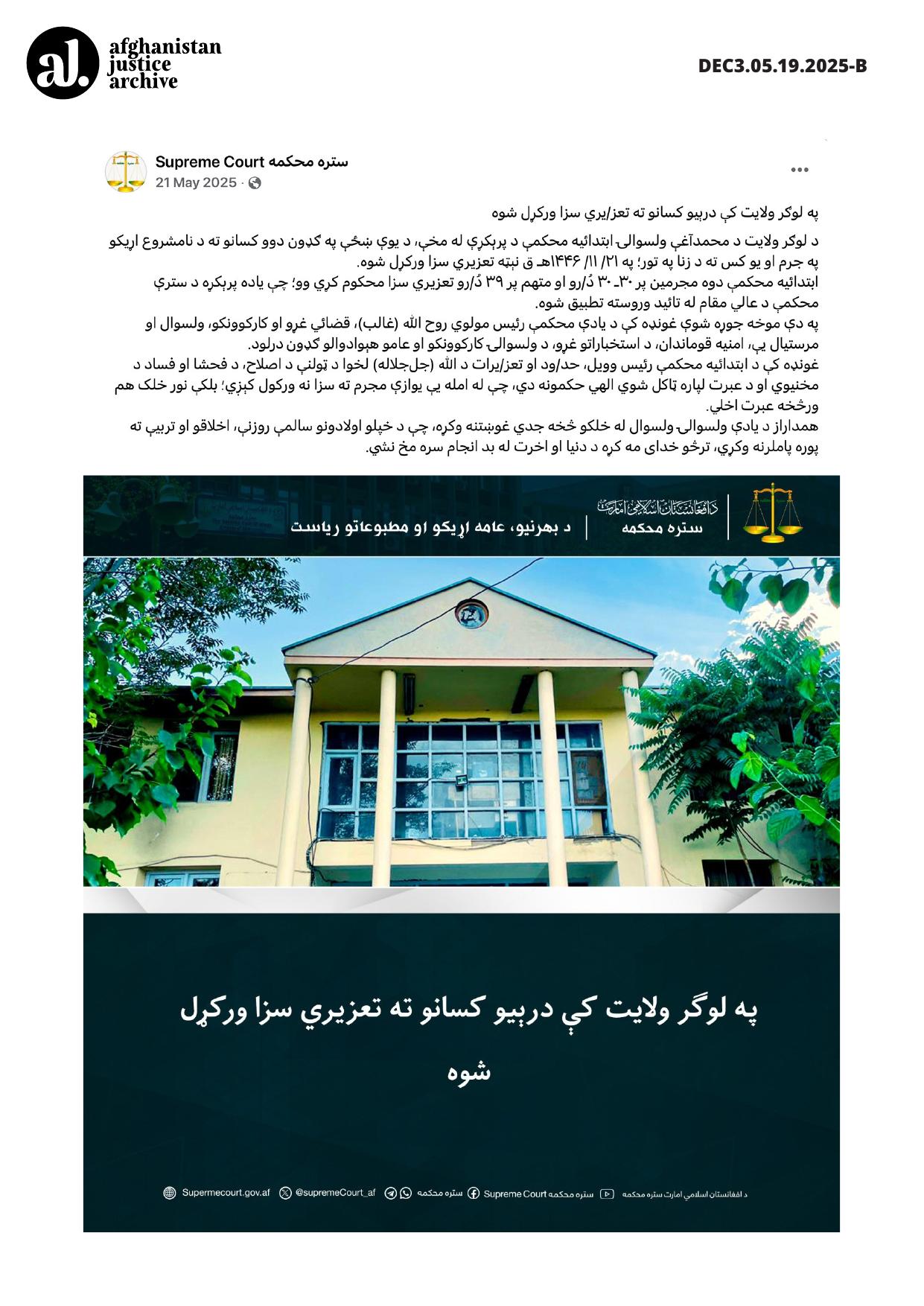
Three Individuals Subjected to Discretionary Punishment in Logar Province
According to the ruling of the Primary Court of Mohammad Agha District in Logar Province, discretionary punishments (taʿzir) were carried out on 21/11/1446 AH against three individuals: two persons—including one woman were convicted of engaging in unlawful relations, and one individual was charged with adultery.
The Primary Court had sentenced the two offenders to 30 lashes each and the accused individual to 39 lashes as discretionary punishment. This ruling was implemented after being approved by the High Authority of the Supreme Court.
The gathering held for the implementation of the punishments was attended by the President of the aforementioned court, Mawlawi Rohullah (Ghalib), judicial members and staff, the district governor and his deputy, the district police chief, members of the intelligence department, district employees, and local residents.
During the event, the President of the Primary Court stated that hudud and taʿzirat are divine rulings established by Allah (Glorified be His Majesty) for the reform of society, the prevention of immorality and corruption, and for providing a lesson to others. He emphasised that these rulings not only punish the offender, but also serve as a deterrent for the broader community.
Likewise, the district governor urged the public to take the upbringing, ethics, and proper guidance of their children seriously, so that they may be protected from negative consequences in both this world and the hereafter.
This entry documents the public implementation of discretionary corporal punishment (taʿzir) in Mohammad Agha District of Logar Province following a ruling by a Taliban primary court. Individuals convicted of adultery and alleged “unlawful relations” were subjected to flogging after approval by the Supreme Court authority. The punishments were carried out in a public gathering attended by judicial officials, local authorities, security personnel, and residents. Statements delivered during the event framed the punishments as religiously mandated measures intended to enforce moral conduct and deter perceived immorality within the community. The incident illustrates the use of corporal punishment and public enforcement as part of the Taliban’s approach to regulating personal behavior and moral norms.
Sources
Original Source Link:
Original Decree File:
Decree Stats
Area of Decree
Issuer
Type of Decree
Targeted Gender
Delivery Method
Date Published