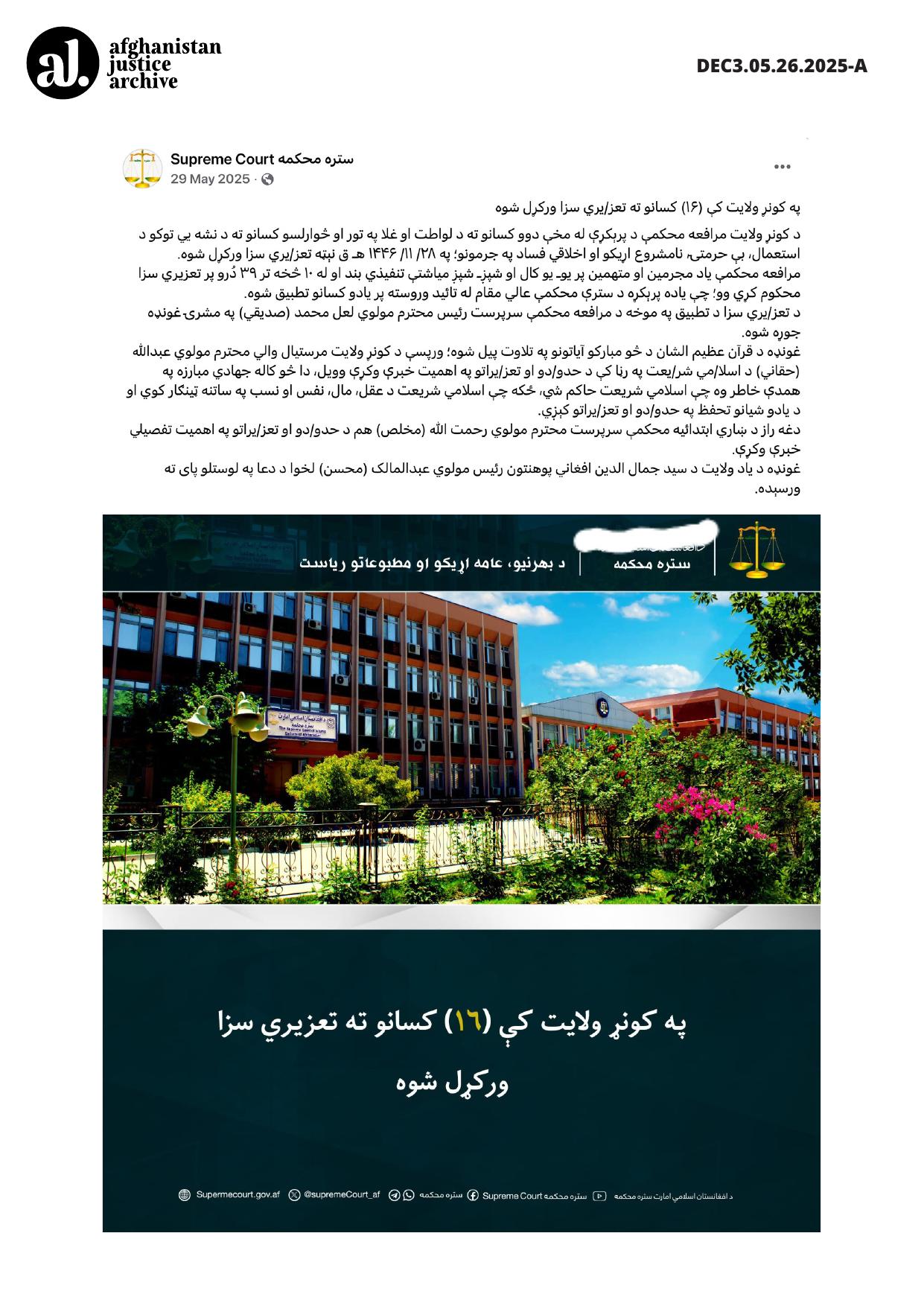
Decree
Decree Translation
Date: 28/11/1446
Sixteen Individuals Subjected to Discretionary Punishment in Kunar Province
According to the decision of the Kunar Provincial Court of Appeal, discretionary punishments (taʿzir) were carried out on 28/11/1446 AH against sixteen individuals. Two of them were charged with sodomy and theft, while fourteen others were convicted of offenses including drug use, disrespect/insult, unlawful relations, and moral corruption.
The Court of Appeal had sentenced the convicted persons and defendants to one year and six months of imprisonment each, along with discretionary lashes ranging from 10 to 39 lashes. These punishments were implemented after receiving approval from the High Authority of the Supreme Court.
A gathering for the implementation of the punishments was held under the leadership of the Acting President of the Court of Appeal, Mawlawi Lal Mohammad (Siddiqi).
The event began with the recitation of several blessed verses from the Holy Qur’an. Afterwards, the Deputy Governor of Kunar Province, Mawlawi Abdullah (Haqqani), spoke about the importance of hudud and taʿzirat in light of Islamic Sharia. He stated that the years of jihad were undertaken for the establishment of Islamic Sharia, which emphasizes the protection of intellect, wealth, life, and lineage—matters safeguarded through the enforcement of hudud and taʿzirat.
Similarly, the Acting President of the Urban Primary Court, Mawlawi Rahmatullah (Mukhlis), delivered detailed remarks on the importance of hudud and taʿzirat.
The gathering concluded with a prayer led by Mawlawi Abdul Malik (Mohsin), President of Sayed Jamaluddin Afghan University in the Province.
This entry documents the implementation of discretionary criminal punishments (taʿzir) in Kunar Province following rulings by the Provincial Court of Appeal. Sixteen individuals accused or convicted of offenses including sodomy, theft, drug use, and alleged moral misconduct were sentenced to imprisonment and corporal punishment. The punishments were carried out after approval by the Supreme Court authority and were accompanied by a public gathering where officials framed the enforcement of hudud and taʿzir punishments as essential to maintaining social order and implementing Islamic law. The case illustrates the Taliban justice system’s reliance on corporal punishment alongside custodial sentences to enforce both criminal prohibitions and moral conduct.
Sources
Original Source Link:
Original Decree File:
Decree Stats
Area of Decree
Issuer
Type of Decree
Targeted Gender
Delivery Method
Date Published