Decree
Decree Translation
Date: 06/12/1446
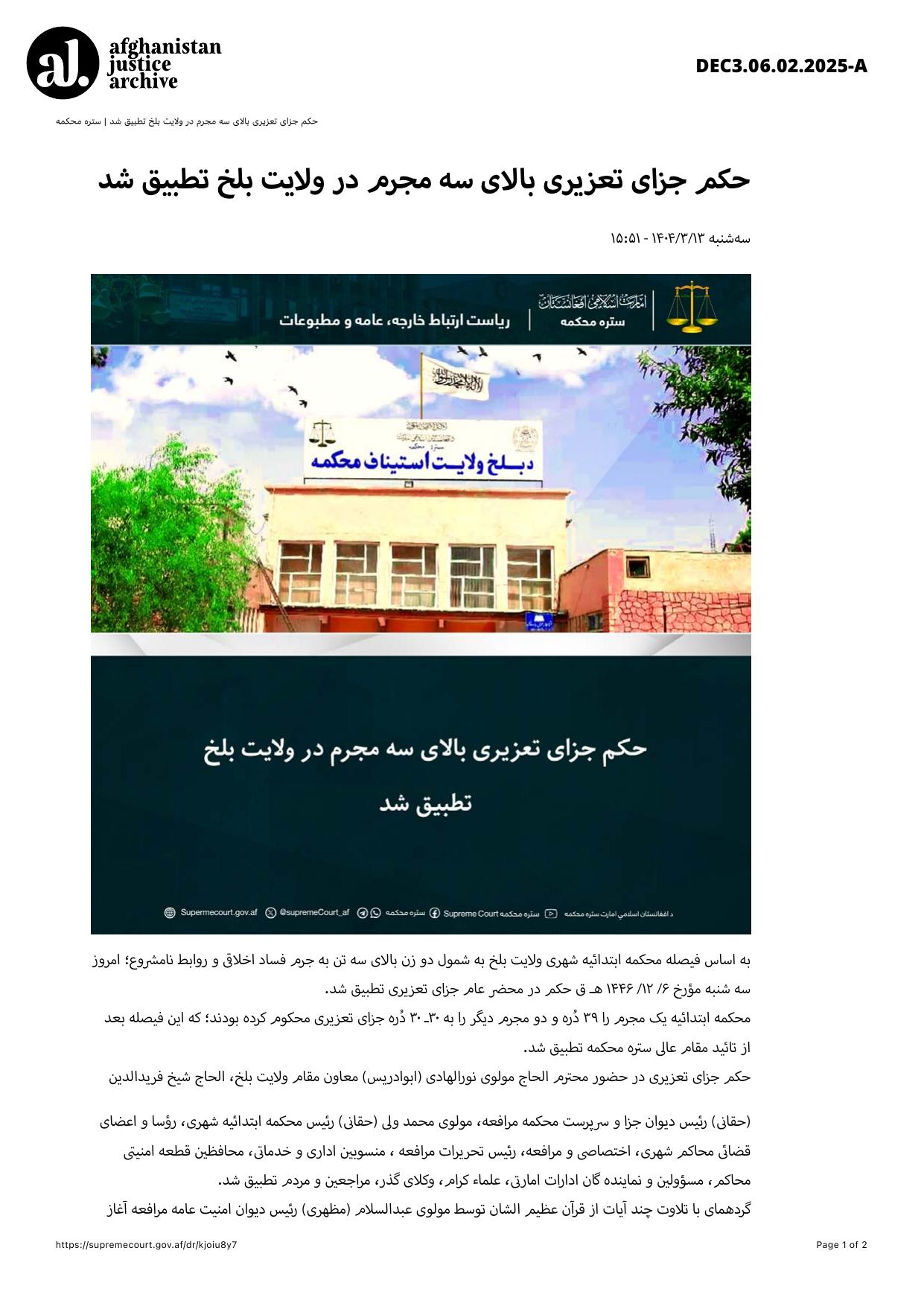
Implementation of Disciplinary Punishment on Three Convicted Individuals in Balkh Province
In accordance with the decision of the Primary Urban Court of Balkh Province, disciplinary punishments were enforced on three individuals, including two women, convicted of moral corruption and illicit relations. The punishments were carried out publicly today, Tuesday, 06/12/1446 AH.
The Primary Court had sentenced one convict to 39 lashes and the other two convicts to 30 lashes each as a disciplinary penalty. This ruling was executed after confirmation by the esteemed Supreme Court.
The disciplinary punishment was implemented in the presence of Honorable Al-Haj Mawlawi Noorulhadi (Abu Idris), Deputy Governor of Balkh Province; Al-Haj Sheikh Fariduddin (Haqqani), President of the Criminal Division and Acting Head of the Appellate Court; Mawlawi Mohammad Wali (Haqqani), President of the Primary Urban Court; heads and judicial members of urban, special, and appellate courts; the Chief Clerk of the Appellate Court; administrative and service staff; security guards of the courts; officials and representatives of Emirate institutions; respected scholars; community elders; visitors; and members of the public.
The gathering began with the recitation of verses from the Holy Qur’an by Mawlawi Abdul Salam (Mazhari), President of the Public Security Division of the Appellate Court. Subsequently, the President of the Primary Urban Court, the Deputy Governor, and the President of the Criminal Division and Acting Head of the Appellate Court delivered speeches, emphasizing that the enforcement of Sharia rulings upon criminals is among the responsibilities of the officials of the Islamic Emirate. They highlighted that the faithful, Muslim, and Mujahid people of Afghanistan have made sacrifices and waged sacred jihad to implement Sharia rulings, eradicate corruption, mischief, immorality, and un-Islamic practices from our society, and establish the system of the Islamic Emirate. Alhamdulillah, today all divine rulings are being implemented in our country.
The gathering concluded with a prayer.
This case reflects the normalization of corporal punishment within the Taliban judicial system as a routine mechanism for enforcing moral-conduct norms, including against women. The public execution and higher-level confirmation of the sentence indicate the institutionalization of physical punishment as a tool of social control rather than individualized justice
Sources
Decree Stats
Area of Decree
Issuer
Type of Decree
Targeted Gender
Delivery Method
Date Published