Decree
Decree Translation
Date: 23/02/1447
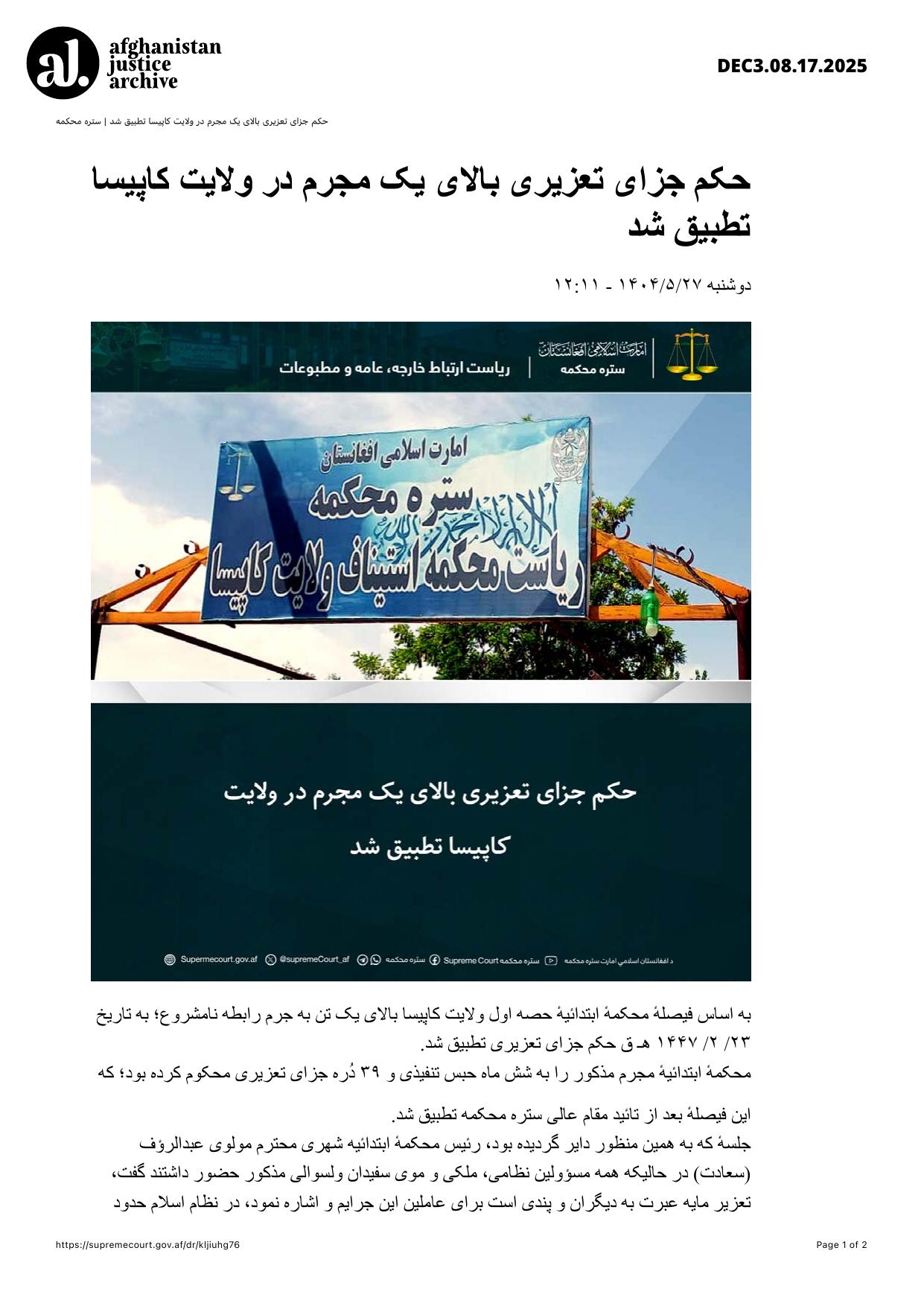
Implementation of Disciplinary Punishment on a Convicted Individual in Kapisa Province
In accordance with the decision of the Primary Court of Hesa-e-Awal District, Kapisa Province, a disciplinary punishment was enforced on an individual convicted of engaging in illicit relations. The punishment was carried out on 23/02/1447 AH.
The Primary Court had sentenced the convict to six months of imprisonment and 39 lashes as a disciplinary penalty. This ruling was executed after confirmation by the esteemed Supreme Court.
During the session convened for this purpose, the President of the Primary Urban Court, Honorable Mawlawi Abdul Rauf (Saadat), stated in the presence of all military and civil officials and local elders that “Disciplinary punishment serves as a lesson for others and a warning to those who commit such crimes. In the Islamic system, the enforcement of Sharia limits and disciplinary measures is a priority, and any violation or disorder within the system of the Islamic Emirate will be pursued with utmost seriousness.”
He further emphasized: “Thousands of Mujahideen have sacrificed their lives, thousands have been wounded and disabled, and thousands of orphans and widows remain—all for the establishment of a Sharia-based system in Afghanistan and the implementation of divine limits in this land. Alhamdulillah, their aspirations have now been fulfilled.”
This entry documents the implementation of discretionary criminal punishment (taʿzir) in Hesa-e-Awal District of Kapisa Province following a ruling by a Taliban primary court. An individual convicted of engaging in illicit relations was sentenced to imprisonment and corporal punishment, with the sentence carried out after approval by the Supreme Court authority. The punishment was implemented in the presence of officials, local elders, and members of the public, accompanied by statements emphasizing the role of disciplinary punishment in enforcing Sharia and maintaining social order. The case reflects the use of corporal punishment and custodial sentences to regulate personal relationships, as well as the ideological framing of punishment as a necessary component of the Islamic system.
Sources
Decree Stats
Area of Decree
Issuer
Type of Decree
Targeted Gender
Delivery Method
Date Published