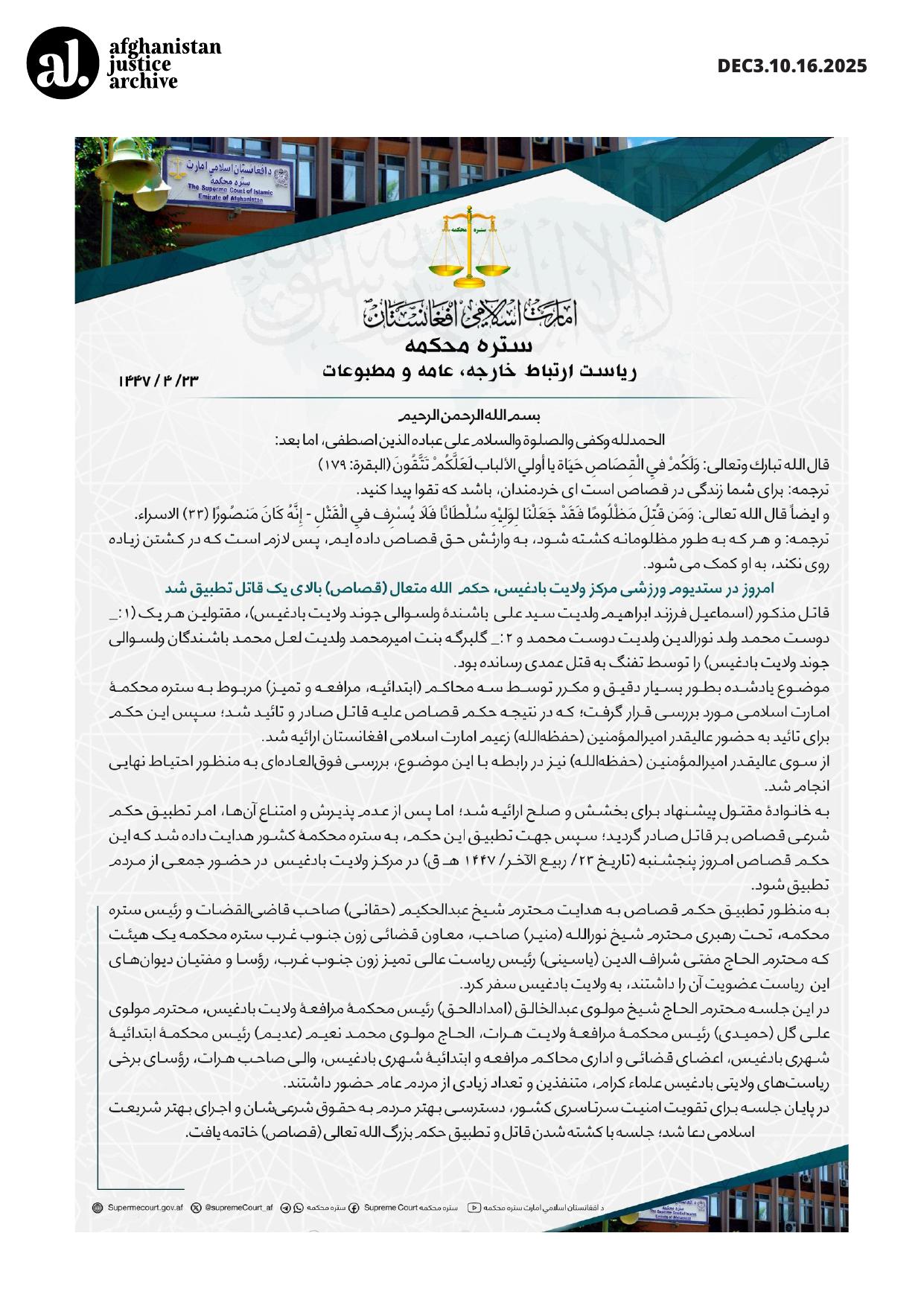
Decree
Decree Translation
Date: 23/04/1447
Department of Foreign Relations, Public Affairs and Media
In the Name of Allah, the Most Merciful, the Most Compassionate
All praise is due to Allah alone, and peace and blessings be upon His chosen servants. To proceed:
Allah the Exalted says:
“And there is for you in retribution (qiṣāṣ) life, O people of understanding, so that you may become righteous.”
(Al-Baqarah, 2:179)
Translation: For you, O people of intellect, there is life in the law of retribution, so that you may attain piety.
Allah the Almighty also says:
“And whoever is killed unjustly—We have given his heir authority, but he must not exceed limits in retaliation, for indeed he is supported.”
(Al-Isra, 17:33)
Translation: And whoever is killed unlawfully, We have granted his heir the right of retribution. He must not exceed the limits in carrying it out, for he will be supported.
On 23 Rabiʿ al‑Akhir 1447, the divine ruling of qiṣāṣ (legal retribution) was implemented on a convicted murderer in the main sports stadium of Badghis Province.
The convicted individual, Ismail, son of Ibrahim, grandson of Sayed Ali, resident of Jund District, Badghis Province, was found guilty of the intentional killing of two individuals—Dost Mohammad, son of Nuruddin, grandson of Dost Mohammad, and Gulbargha, daughter of Amir Mohammad, granddaughter of Lal Mohammad—also residents of Jund District. The murders were committed with a firearm.
This case underwent extensive and repeated examination through the three judicial levels:
Primary Court,
Court of Appeal, and
Supreme Court (Panel for Review) of the Islamic Emirate of Afghanistan.
Following thorough review, the ruling of qiṣāṣ against the convicted individual was issued and confirmed. The judgment was then submitted for final approval to the Esteemed Amir al‑Mu’minin (may Allah protect him), the Leader of the Islamic Emirate of Afghanistan.
The Amir al‑Mu’minin (may Allah protect him) conducted an additional exceptional review to ensure the utmost level of caution.
The family of the victims was offered the opportunity to grant pardon and reconcile; however, they declined and insisted on the implementation of the legal ruling. Consequently, the order to carry out qiṣāṣ was issued and forwarded to the Supreme Court for execution.
In accordance with this directive, the qiṣāṣ ruling was implemented today, Thursday, 23 Rabiʿ al‑Akhir 1447, in the provincial center of Badghis, in the presence of local residents.
To oversee the implementation, and under the guidance of Sheikh Abdul Hakim Haqqani, Chief Justice and Head of the Supreme Court, and under the leadership of Sheikh Noorullah Munir, Deputy Chief Justice for the Southwest Zone, a delegation traveled to Badghis. The delegation included Haji Mufti Sharafuddin Yasini, Head of the High Review Directorate for the Southwest Zone, along with various directors and jurists from the relevant judicial departments.
Present at the gathering were:
Haji Sheikh Mawlawi Abdul Khaliq Imdadul Haq, Head of the Badghis Provincial Court of Appeal;
Mawlawi Ali Gul (Hamidi), Head of the Herat Court of Appeal;
Haji Mawlawi Mohammad Naeem (Adim), Head of the Badghis City Primary Court;
Judicial and administrative members of the Courts of Appeal and Primary Courts of Badghis;
The Governor of Herat;
Heads of several provincial departments of Badghis;
Religious scholars, community elders, and a large number of local residents.
At the conclusion of the session, prayers were offered for nationwide security, improved public access to their lawful rights, and the better implementation of Islamic law.
The gathering concluded with the implementation of the ruling and the execution of the convicted murderer, thereby carrying out the prescribed legal punishment of Allah Almighty.
This entry documents the public implementation of qiṣāṣ (legal retribution) in Badghis Province, resulting in the execution of an individual convicted of murder following multi-level judicial review and final approval by the Taliban’s supreme leadership. The public execution, carried out in a stadium in the presence of officials and residents, reflects the institutionalization of capital punishment within the Taliban’s judicial system and its use as a visible form of enforcement. The involvement of senior judicial authorities and central leadership underscores the integration of judicial, religious, and executive power in the administration of punishment.
Sources
Original Source Link:
Original Decree File:
Decree Stats
Area of Decree
Issuer
Type of Decree
Targeted Gender
Delivery Method
Date Published