Decree
Decree Translation
Date: 27/08/1403
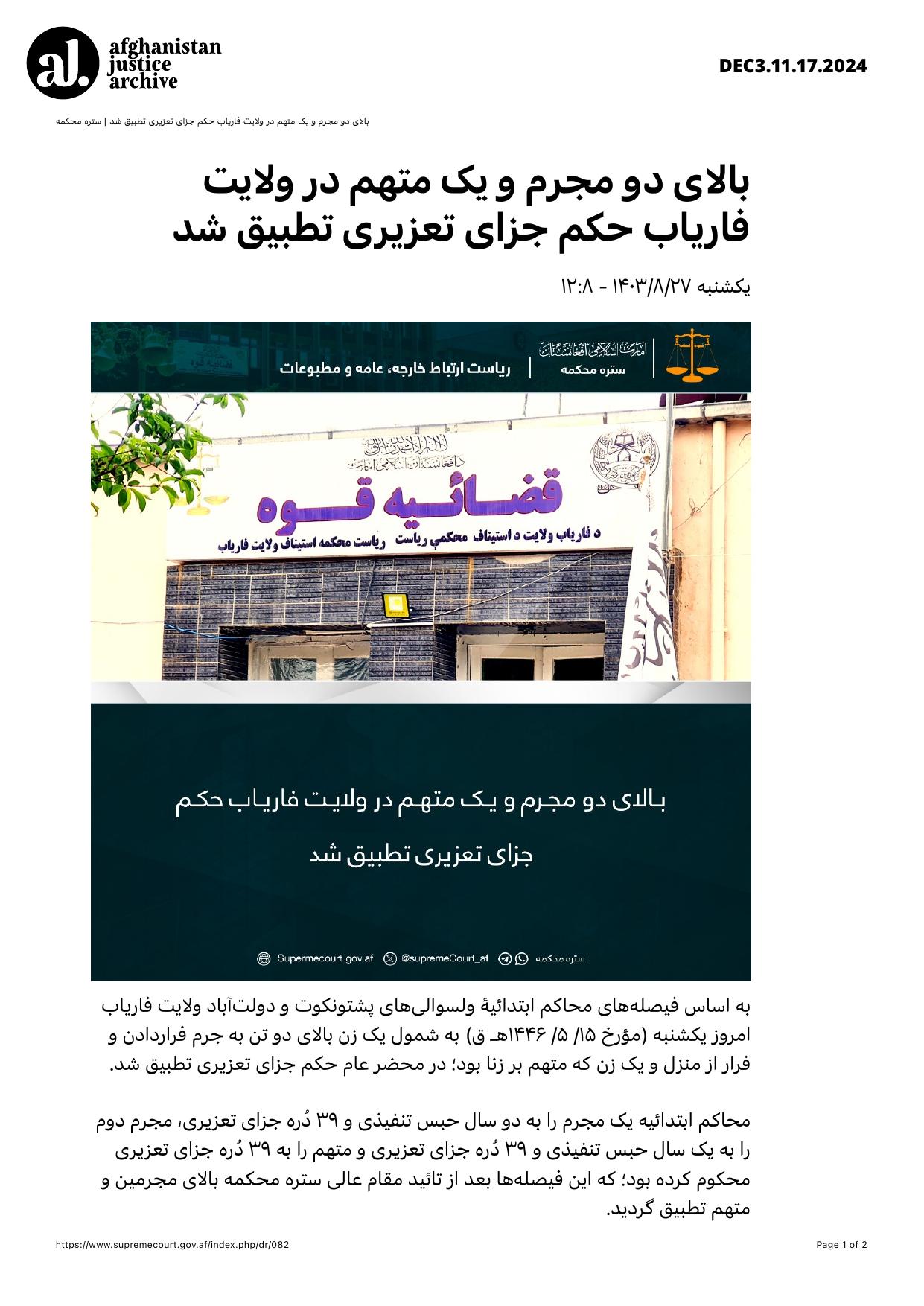
Implementation of Discretionary Criminal Sentences Against Two Convicted Individuals and One Defendant in Faryab Province
Based on the rulings of the Primary Courts of Pashtunkot and Dawlatabad Districts in Faryab Province, discretionary criminal sentences were executed today, Sunday (15/05/1446 Hijri Qamari), in public against three individuals — including one woman. Two individuals were convicted of aiding and abetting escape and fleeing from home, while the third, a woman, was accused of adultery.
The Primary Courts had sentenced one convicted individual to two years of enforceable imprisonment and 39 lashes, the second to one year of enforceable imprisonment and 39 lashes, and the accused woman to 39 lashes as discretionary punishment. These rulings were implemented following their approval by the Supreme Court.
The public gathering held for the implementation of the sentences was attended by Al-Haj Mawlawi Ali Gul (Hamidi), Chief Justice of the Appellate Court, judicial members, civil and military officials, religious scholars, and a large number of local residents.
During the session, the court rulings and the Supreme Court’s confirmation orders were publicly read aloud.
The gathering concluded with prayers following the execution of the discretionary punishments.
This incident documents the public implementation of corporal punishment and imprisonment following discretionary court rulings approved by higher judicial authorities. The enforcement of public lashings, accompanied by the formal reading of court decisions and prayers, reflects the continued use of punishment as a performative and coercive tool of governance. The prosecution of a woman for “adultery”, together with charges related to “fleeing from home,” demonstrates the criminalization of women’s autonomy, privacy, and movement through moral offenses. The punishments imposed constitute cruel, inhuman, or degrading treatment, and raise serious concerns regarding fair trial guarantees, liberty, non-discrimination, and gender-based persecution.
Sources
Original Source Link:
Original Decree File:
Decree Stats
Area of Decree
Issuer
Type of Decree
Targeted Gender
Delivery Method
Date Published